Showing posts with label dark procurement. Show all posts

Friday, 2 August 2013

Execution bottlenecks in procurement

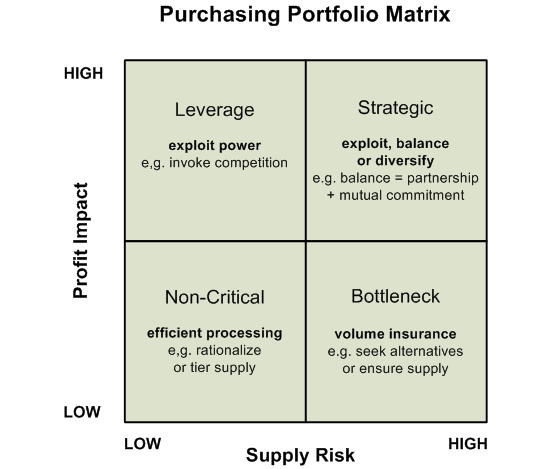
I have always been surprised at how difficult it is for workshop delegates to populate the 'Bottleneck' quadrant of a Kraljic matrix - those procurements which although potentially low price have such an strategic impact on the organisation that they can 'stop the line'.

There appears to be something built into the DNA of those who discuss procurement to focus on managing big sums of money as opposed to managing risks - low value is the unglamorous side of procurement. Yet, delivering great procurement is about identifying the right strategy for all sorts of procurements, including those which are low value but high risk.

You may recall my previous post on the strategic significance of a $10 hinge on laptops - that was an example of a 'Bottleneck' item.

Today (2 August 2013) we have learnt of a somewhat dark procurement example, the dilemma facing the state of Texas as it faces a potential shortage of drugs used for lethal injections for those who it seeks to speed on their journey to the next life through execution. Whether or not you think such a shortage is a good thing is not the point - the issue is a change in the external environment which led to a shortage of supply, in this case relocation of a key supplier to a country which does not want to be associated with execution. I feel it would be totally inappropriate for me to suggest alternative options for the state of Texas but they will need to have some solutions before the end of September [2013].

One of the problems with 'bottleneck' items is that because they are low value they are rarely picked up through a spend analysis which is an over simplification of where to focus attention.

So now you have two examples of 'Bottleneck' items but how specific can you be in identifying your own organisation's or is that a risk not yet managed?

PS: 30 April 2014 As if Texas wasn't bad enough, Oklahoma ended up with botched executions and calls to reveal their suppliers of legal injections.

Wednesday, 12 June 2013

Intriguing procurement: BGT, Twitter-gate and PRISM

What have the Britain's Got Talent egg-thrower, Twitter-gate and PRISM got in common? Well the answer is they are all had contractors who behaved inappropriately, and brought embarrassment and loss to their client.

Last week I posted a blog on Dark Procurement which was previously a guest post on Spendmatters - it was fascinating to read some of the comments on the Spendmatters' post. I think it is fair to paraphrase the comments as saying, 'CPO's should act in line with their personal beliefs and conscience even if those personal beliefs are in conflict with those of their employer.

In BGT, Twitter-gate and PRISM we see examples of the contractor acting on their judgement/conscience as opposed to the clients - I'd really like to hear from CPOs who believe that's acceptable performance of a contract? But isn't the argument that CPO's should act on their conscience something similar?

What these examples highlight is moral hazard. When you're dealing with individuals who provide some form of personal service you face the risk of 'will they do what they're supposed to', which isn't easy to protect against. So we have Simon Cowell with egg on his shirt; Newsnight resignations; loss of Booz Allen Hamiton's share value;  NSA, GCHQ and the Foreign Secretary all being diverted from what they should be doing and paying a high cost due to a maverick contractor.

It really doesn't matter whether or not you believe the maverick was 'doing the right thing' if you were the CPOs who bought them but it does matter if the CPO didn't demonstrate due diligence.

Thursday, 6 June 2013

The ethics and moral dilemma of Dark Procurement

A judge has ruled that an accountants job is to cut bills even if that relates to tax avoidance.

That ruling provides justification for sharing this blog which was original posted as a guest blog on Spendmatters:

The tragedy of the Dhaka factory collapse, which led to the death of over 1,000 innocent factory workers, has placed some procurement strategy under a cloud. There is a dark side of procurement with moral dilemmas which recognises there is more to ethics in procurement than the CIPS code.

Those directly responsible for the supply chain management of clothes with a 'Made in Dhaka' label are faced with a question as to whether or not this is something they would want to include on their CV or LinkedIn profile. While you would not necessarily be proud of sourcing from the Dhaka factory, is buying from low price sources such a bad thing if you are the CPO and that's what achieves the organisation's strategic objectives?

If there is a perception that buying cheap clothes for retail is distasteful, is there not also an element of public service linked to making available low price clothes for those who have to 'watch every penny'? 

There is another dark side of procurement; buying things which society would not necessarily celebrate. Buying some things must cause personal dilemmas for CPOs but that doesn't mean the CPO has no conscience and is a 'baddie'. The CPO must focus on delivering the best professional procurement, regardless of whether or not they agree with the policy. Arguing that poor procurement is justifiable in bad situations just doesn't add up.

There are other examples of dark procurement. For example, I found it quite bizarre when I learnt of the procurement team at a missile manufacturer seeking accreditation of their approach to environmental management. It seemed very odd to me that, when buying for the manufacture of something which will cause mass destruction, you want to be sure that you minimise environmental impact! Maybe it's not so strange but just professionalism?

Then we have the interesting position of buying ropes for the hangman. Yes, someone has to do that, as has recently been highlighted through a procurement exercise in India. You may be completely against the death penalty and even a sympathiser with some of those awaiting the death penalty for political reasons. But does it not make sense to ensure that the hangman's rope is the most fit for purpose and the most merciful? Shouldn't the best of professionalism in procurement be pursued even in such dilemmas?

Moral dilemmas and ethics work both ways too. It would be wrong for a CPO to go on a personal crusade pursuing their own political, social and religious beliefs if they do not coincide with the strategic position of their employing organisation. Wouldn't that be non-professional?

So, say for example, the leadership of the organisation where you are the CPO has consistently demonstrated cynicism of global warming. You believe in sustainable procurement and that it will benefit society in the long term - the Board don't agree. You are asked to procure a major piece of equipment. You delegate the work to your deputy. Your deputy however, is passionate about sustainability - they believe with their heart 'green is best' and progress a procurement which results in two offers, one 0.5% higher than an alternative option. The only difference between the two bids is the environmental impact. The additional cost for the environment offer is £1m. Your deputy recommends the higher, 'green' bid. You sympathise with your deputy but what are you going to recommend to teh Board?

Does professional procurement have room for a conscience - that in itself is a dilemma which doesn't appear to feature much in discussion.

NB This blog was first published as a guest blog on Spendmatters on 15 May 2013