Showing posts with label case study. Show all posts

Sunday, 1 January 2017

Another misreading of relative power in buyer/supplier negotiations

Once more we learn of what looks like another misreading of relative power in buyer/supplier relationships; this time M&S.

There's no need to retell the whole story which was published in today's Sunday Times, but it appears M&S, by pursing a responsible sourcing strategy, reduced its potential supply base and therefore ease of switching suppliers. Then, in response to the weakening exchange rate following the Brexit vote, refused to work with suppliers in addressing their cost increases, but instead said they were going to consolidate the supply base, therefore exerting power over suppliers yet reducing suppliers long-term 'skin in the game'. Then, facing potential loss of supplies (relative supplier power) have now had to backtrack on their earlier assertion and accept supplier price rises.

Not only has M&S lost face in this foray they have needlessly sacrificed supplier goodwill and trust, and quite possibly lost credibility in their narrow interpretation of responsible sourcing.

I do not understand why procurement strategists appear to spend insufficient time thinking through potential scenarios and likely supplier responses; they would benefit a lot from game theory by considering "how might our suppliers respond". M&S don't seem to have thought through potential outcomes prior to pursuing any of the above approaches.  'Power' appears to be viewed solely as one-way and risks dismissed.

As we start 2017 I doubt this will be the only example of misreading power in buyer/supplier relationships - why is that; why are we so poor at learning lessons for others?

Friday, 25 March 2016

Tales of the unexpected, Harmeston & procurement leadership lessons

I do not recall when the professional credibility of a CPO has received as much attention as that of Kath Karmeston (for example,  The Guardian, FT,  and The Times).  Harmeston already had a significant profile, largely through the reputation she gained as Royal Mail's CPO, before moving to the Co-op.  At the Co-op she became responsible for cutting the costs of the >£1bn spent on 'goods not for resale', and The Times claims she was paid £357k a year for that!

However, after a remarkably short stay, say ten weeks, Harmeston and the Co-op parted company. Harmeston decided to pursue a claim of £5.2m for unfair dismissal (I've no idea how that figure was calculated and some would say it was an unachievable negotiating position). Whether intended or not, Harmeston brought the spotlight on herself through the decision to go to the tribunal. You can read the Co-operatives version of the Tribunal here.  Now after almost two months of waiting for an answer, it is reported she has failed in her claim against the Co-op for unfair dismissal.

I am not competent to comment on the legal aspects, and feel a slight discomfort intruding on private grief, but I can have an opinion on some of the alleged practice reported in press - let's remember this blogpost is based on reported evidence and some of the evidence was contested.  Much of evidence struck me as irrelevant to the unfair dismissal case but relevant to the profession and those who would hope to bring about procurement change - it's those areas I discuss below.

We are told Harmeston believed she had uncovered a lack of procurement policy compliance; 70% of the budget. Understanding the extent of non-complaint spend is certainly a good starting position for improvement - understanding 'why' and what to do about it would be an even better position. The CEO though claimed the issues raised by Kath were already known about and Kath had previously been briefed on them. It is always dangerous to claim the glory for uncovering something when others say you didn't - that applies just as much to claiming savings in isolation of the budget-holder's contribution. 

Nevertheless, when the Co-op's head of group risk probed Kath, he concluded that the CPO didn't know the details of the procurement policy. Now given that she was only in post ten weeks, it could be argued that was understandable. What strikes me as unacceptable though was his assertion:
Policy process and governance she defaulted to [her deputy] because she felt it was beneath her. 
Anyway, that was made worse by, Paula Keegan, the former group chief strategy officer's opinion that Harmeston knowingly chose to break the Co-op's procurement policy herself.

I cannot think of any situation when procurement governance should not be a primary concern when seeking to bring about procurement change, indeed even setting the example of compliance.

Perhaps you can already sense the loneliness of the CPO's journey. To me, when you want to bring about procurement change you also need a coalition of allies - the CEO, head of group risk and group chief strategy officer would be useful allies but Kath failed to gain their ownership.

Nevertheless,

Sunday, 12 October 2014

More Teswoe's - and thoughts on the linkage of Marketing & Procurement Strategy

With the slogan 'Every little helps' Tesco are also sure to understand the drip, drip, drip of every little piece of negative publicity also counting. I have given considerable attention to Tesco's approach to procurement over the years and how it may not have been just exemplary as others argued.

However, today's Sunday Times article drew my attention to an aspect of Tesco procurement strategy that I previously hadn't considered, namely, minimising customer choice. I just hadn't considered that the strong arm of Tesco's buyers were suspending products from the shelves - customers were being deprived of choice by Tesco. Of course the suspension also had a painful impact on suppliers. Ironically Premier Foods lost £10m in three months. I say ironically as you may recall, some months ago, I referred to Premier Foods bizare approach to defining strategic suppliers.

While these case studies are of interest to the procurement world, to me they are also of interest to those interested in Marketing Strategy. Did Marketing in Premier Foods position Tesco as strategic - clearly Tesco's Procurement Strategy didn't position Premier Foods as strategic. And what about the reputational damage caused by Tesco's Procurement Strategy - never mind that a number of the Tesco staff are now suspended, how much will Brand reconstruction cost. Wouldn't it be interesting to read the brief for the procurement of that Brand agency who have to undo the damage caused by Procurement!

Saturday, 14 June 2014

The state of UK public procurement 2014


This paper celebrates the application of good procurement practice in user engagement throughout the procurement cycle, adoption of a category management approach, inclusion of social benefit clauses, use of eAuctions, collaborative purchasing beyond supplies, and environmental purchasing. However, by implication, the paper also suggests there is also significant room for improvement through the wider application of user engagement throughout the procurement cycle, adoption of a category management approach, inclusion of social benefit clauses, use of eAuctions, collaborative purchasing beyond supplies, and environmental purchasing. These improvements would deliver cost reductions and improved public services, objectives of the public sector throughout the world. The challenge is now to understand what contributed to the exemplars being able to bring about the change and accelerating the transference of that good practice throughout the public sector.

Sunday, 25 May 2014

Procurement Fraud Vulnerability: A Case Study

This case study reports on a due diligence review of vulnerability to procurement fraud in a global manufacturing organization. The review was carried out in response to the UK Bribery Act 2010’s need for organizations to put in place processes to protect against bribery in procurement. The case study organization was identified as having 41 areas of vulnerability to the risk of procurement fraud; illustrative examples are provided. It is argued that due diligence reviews to protect against procurement fraud could help in repositioning procurement and reduce costs. The article also poses the question: Are employees owed a duty of care by their employers to protection against allegations of procurement fraud?
This is an abstract of my paper published in EDPAS (EDP Audit, Security and Control) Newsletter which can be accessed here.

Tuesday, 1 April 2014

CIPS scores a masterful coup with Borgen procurement training video

I was really disappointed when I heard, last year, that Borgen, the Danish political drama, had finished. Borgen had been some of the best TV I'd seen - compelling viewing and impossible to predict what would happen next.

Borgen was a great example of a successful BBC make/buy appraisal. Auntie just doesn't seem able to produce such a consistently high quality series', so it was a clever to buy from Denmark rather than even attempt to compete by making.

We have all had enough long-running TV series' constructed around regional accents and although I generally have problems with sub-titles that wasn't a problem I had with Borgen. Would it be worth experimenting with subtitles on Eastenders, Coronation Street and Hollyoaks to see if they become more compelling viewing?

Borgen must also have been a tremendous success for the Danish tourist board. I suspect their marketing research now finds that when someone now asks: "What comes to mind when you think of the word 'Danish'?", responses have now moved beyond Danepak, Carlsberg, and pastry to include Borgen. That's a big success and is believed to contribute to the 0.23% increase in the Copenhagen tourist footfall.

So beyond make/buy lessons, what's all that got to do with procurement? As a stroke of genius, CIPS and CCS have entered into a partnership with DUPE (the Danish Unification for Public Procurement Eccord) in commissioning a public procurement training video for politicians based on Borgen. As I understand it, Borgen's central character, Birgitte Nyborg, finds herself faced with calls for her resignation as a result of a scandal involving the CPO and the Danish Chief Secretary to the Treasury. CIPS' press release states that "the video helps demonstrate the need for a clarity of roles between politicians and officers". CIPS also claim that this is a central part of their marketing strategy and is the first of a range of procurement resources using of subtitles due to ease of being able to provide translations. Consistent with that strategy, DUPE have priced for the first and second phases of translations. The first phase of translations are targeted for Belize, Botswana, Kenya, Fiji, Jordan, and Namibia; and the second phase translated for Mauritius, Malta, Nigeria, and the Philippines. It is understood that a recommendation for Cyrillic is being considered by CIPS Congress as part of a wider package of translation of all CIPS resources on public procurement and piloting of CIPS Licence.

Sunday, 30 March 2014

Calculating total acquisition costs: the case of the aircraft carrier.

Every good procurement person knows you should calculate Total Acquisition Costs and they need to be included within the business justification. But whose responsibility is it to identify all the potential costs and factor those into the business case and options appraisal? Equally, whose responsibility is it to identify the various dependencies which will impact on a successful delivery?

For example, when Northern Ireland recognised the need for a better Dublin to Belfast train, it was quite late in the day they discovered the platform in Belfast's new station in the centre of the City was too short to accommodate the train and many of the bridges en route too low for the train to go under - that leads to significant extra costs, which add to the costs of the procurement.

As much as that may seem impossible to believe the MOD appear to have given us another example, had it been two days later you may well have suspected an April Fool.

Aircraft carriers are big cost, in this case the budget cost has now risen from £800m to £6.2bn, yes, billion. But aircraft carriers don't just stay at sea. In this case the idea was that the carrier should be based at Portsmouth. Unfortunately the new carrier won't fit into Portsmouth harbour. To make the hole fit the ship £40m needs to be spent on dredging a new 30 foot deep channel. Fine, but then we discover that the dredging can't be carried out more than a year in advance because the harbour would silt up again - hold on a sec., does that mean that dredging, at £40m isn't a 'one-off' cost but a running cost?Who picks up that tab? In addition to the dredging, the jetty needs to be strengthened. Then there are concerns about the demand on the local electricity supply when the carrier is in port - can the network handle the demand or will additional investment be required there too?

How on earth could Procurement have been expected to know those costs? I think most would agree they wouldn't. But then someone has to ask the questions about dependencies and costs, and if Procurement don't ask those questions, we can't assume anyone else will.


Friday, 28 March 2014

PSNI dysfunctional procurement strategy: A case study or 'who done it' mystery?

Two years ago I discussed the PSNI's procurement of temporary staff, many of whom had just retired from jobs in the same organisation. This week the Northern Ireland Assembly's PAC published its inquiry report - ten recommendations of which seven relate to procurement. The 'case' should be of interest to all those organisations which make use of Agency staff. 

Those with an interest in procurement strategy as opposed to public policy could look at the Inquiry slightly differently. Is this one of the few situations where there is evidence of a procurement approach actually working in opposition to the intended outcome of the legislation? Cynically, was a procurement approach requested which would satisfy the PSNI's (Police Service of Northern Ireland) objective of 'getting round' the need for changing the personnel? Put slightly differently, was this an 'intended strategy' to match objectives set for procurement or an example of poor procurement?

First, some background. The transformation of the make-up of the police was one of the core commitments of the Good Friday (Northern Ireland Peace) Agreement. Basically there was a desire to have a smaller police service (a peace dividend) and more balance in the mix of Protestant/Roman Catholic police officers. Former RUC (Royal Ulster Constabulary - the old police service) officers were given the option of early retirement while a parallel recruitment campaign was put in place to balance the make-up of the new PSNI ). But the procurement approach resulted in more than 1,000 retired RUC officers, 19% of those who took early retirement, being brought back as agency workers to the new PSNI. £106m was spent between 2004 and 2012 on these Agency staff who had just left the RUC. Had those offices been reemployed directly by PSNI they would have had to repay their severance lump sum, which was not the case if they were hired as Agency staff.

Yet again, there was a lack of competitive tendering (you may also find Peter Smith's post today on a similar issue at MOD of interest). The service delivery commenced in 2002 but the competitive tendering was only in 2008. There had been a legacy contract in place for permanent staff which had a throughput of £2m per year, but a variation on that contract to include 'temps' led to a spend of £44m over four years.

Thursday, 20 March 2014

Celebrating GO Excellence in Public Procurement Awards 2014/15

Last night it was my pleasure to be at the GO Awards dinner; a great event. I had tried to take and tweet a pic of each of the winners but unfortunately the battery of my Blackberry died and I'd left my recharger in the room - sorry.

Although I had been one of the judges, we had worked in two groups, so the some of the Awards were surprises to me. In fact many of the Awards were surprises to me. Not because I hadn't actively participated in the judging but because there were so many good entries my memory had been clouded - many of the runners-up could have won in a different year. Yes, the quality of public procurement, assuming the entry submissions were telling the truth, was very high. Many of the entries exemplified excellence in procurement, not just public procurement, excellence in procurement, regardless of the sector.

Crossrail in partnership with LUL (for two of the entries), absolutely cleaned up, and to crown it all, their Procurement Director, Martin Rowark, won the Outstanding Contribution Award. As I implied, it is interesting that the categories were judged by two different groups of judges and they came through so strongly. I would encourage them to publish their case studies on their own website.

Nevertheless, I sincerely hope the good folk at BiP come up with some pragmatic way of sharing all the case study entries - it would be really sad if they just remained on judges memory sticks. I don't know how they will do it, but to me a series of YouTube type things followed up with Q&As using social media would be really useful. Indeed, is there any reason why those shortlisted couldn't post their own YouTube stories on their own websites? Anyway, I don't think it is my place to share the IP here.

Monday, 18 November 2013

Testing mini-break shopping and considering the options

The wonders of the web and absentmindedness of those who provide visibility of pricing on it never cease to amaze me.

I wanted to have a quick break linked with returning my son to his student flat in Edinburgh. A quick search found very attractive accommodation which suited us very well on Visit Scotland's website. Visit Scotland revealed a price of £x for four nights in a family room with our 16 year old daughter. However, trying to book I was redirected from Visit Scotland to the accommodation provider's own site. Unfortunately, that booking portal had the inconsistency of a maximum age of 15 for a child. Nevertheless, the websites both yielded the same price. I despatched a quick email to the accommodation to confirm availability but was offered a rate 24% higher than both Visit Scotland and the provider's own site.

Naturally, when I asked them to check their figures against both their own and Visit Scotland's website, the price was reduced.

There was always a slim chance I would be able to beat the web price through the email but why on earth would they price dearer?

Nevertheless, we had a great break but, much as I have a fondness for Scotland and my assumed historical roots, by way of price comparison, is there not something wrong when I can book a mini-break in Berlin, flying from Dublin and staying in a really good hotel, significantly cheaper than a car-ferry from Northern Ireland to a guest house in Scotland?


Friday, 2 August 2013

Execution bottlenecks in procurement

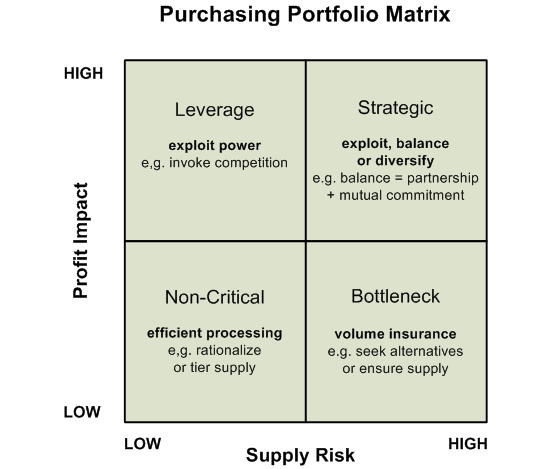
I have always been surprised at how difficult it is for workshop delegates to populate the 'Bottleneck' quadrant of a Kraljic matrix - those procurements which although potentially low price have such an strategic impact on the organisation that they can 'stop the line'.

There appears to be something built into the DNA of those who discuss procurement to focus on managing big sums of money as opposed to managing risks - low value is the unglamorous side of procurement. Yet, delivering great procurement is about identifying the right strategy for all sorts of procurements, including those which are low value but high risk.

You may recall my previous post on the strategic significance of a $10 hinge on laptops - that was an example of a 'Bottleneck' item.

Today (2 August 2013) we have learnt of a somewhat dark procurement example, the dilemma facing the state of Texas as it faces a potential shortage of drugs used for lethal injections for those who it seeks to speed on their journey to the next life through execution. Whether or not you think such a shortage is a good thing is not the point - the issue is a change in the external environment which led to a shortage of supply, in this case relocation of a key supplier to a country which does not want to be associated with execution. I feel it would be totally inappropriate for me to suggest alternative options for the state of Texas but they will need to have some solutions before the end of September [2013].

One of the problems with 'bottleneck' items is that because they are low value they are rarely picked up through a spend analysis which is an over simplification of where to focus attention.

So now you have two examples of 'Bottleneck' items but how specific can you be in identifying your own organisation's or is that a risk not yet managed?

PS: 30 April 2014 As if Texas wasn't bad enough, Oklahoma ended up with botched executions and calls to reveal their suppliers of legal injections.

Wednesday, 17 July 2013

The unfortunate case of sponsorship procurement: A case study

I recently discussed the procurement of sponsorship - little did I realise that procurement of sponsorship would become quite a big political issue for London so quickly. Now we learn that Boris has found terms written into the sponsorship agreement of the Emirates Air Line (Cable Car) so unpalatable that a re-write of the 10 year sponsorship deal is required.

The are at least five issues;

  1. The average man in the street knows Boris Johnston is quite outspoken - how was he unaware of a constraint in the sponsorship deal which prohibits any criticism of the deal, the UAE royal family and government? That was a big constraint but also the associate risk required careful management and a high-level of awareness;
  2. The contract would be in breach if the cable service is sold off or assigned as security to a 'conflicting person' or business from a country with which the UAE has no diplomatic relations - which effectively includes any Israeli linked business - how was that constraint signed;
  3. Given the alleged "anti-Israeli" clause, was the contract subjected to any equalities impact assessment?
  4. Were procurement even involved in this deal?
  5. How many other sponsorship contracts exist within TfL which have not been risk assessed?
We are told the contract will now be rewritten - the need for a rewrite is not only an embarrassment but also recognition of a failure to get it right in the first place. This is a lesson for all - get on top of procuring sponsorship before it get's on top of you. The acceptance of the need for contract re-negotitions in the public sector is becoming all to frequent an occurrence - just how long will this be considered reasonable?