Showing posts with label risk. Show all posts

Friday, 23 June 2017

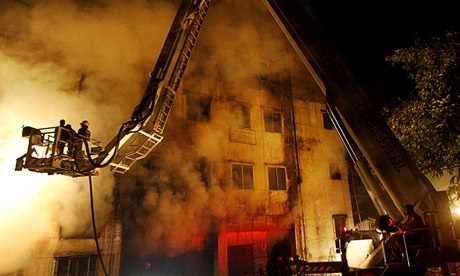
Grenfell Tower: Could procurement help reduce the current risk?

Few could fail to be affected by the tragic disaster of Grenfell Tower. Understandably there has been a clamour for a quick response to reduce the risk of a repeat, but I wonder if the potential use of procurement as a speedy risk mitigator is being overlooked.

Attention is being given to having the cladding on something like 600 tower blocks tested and fire inspections carried out.  While that will provide some comfort and be politically expedient it there may be faster ways in providing reassurances to those potentially at risk.

Let's face it for cladding to have been installed there needed to be a specification, a contractor and a completion. Would it not be possible to use make use of that trio for providing a quicker response:

  1. Each landlord checks the specification for cladding to see if, with the benefit of hindsight, it satisfies today's safety requirement; (If landlords don't have the capability then perhaps some central support could be provided to QA the specification);
  2. If the specification is considered 'fit for today's needs' we then ask the contractor for a written undertaking as to whether they fitted the specified cladding. Failure to give that undertaking could be place the contractor on a 'naming and shaming list' and potentially be taken into consideration in the award of future contracts. Health & Safety legislation and Contract Law could be used to address those who feel short in delivering the specification;
  3. If the specification is no longer acceptable then at least we have a short list to progress for further prioritisation;
  4. Where the specification is appropriate and the contractor provides an undertaking that they complied, then you can provide some reassurance to residents and move those site visits further down the queue;
If I am correct, this strategy could provide reassurance in hours rather that weeks. Document analysis and quality assurance is at its core rather than the much slower inspection and testing. Is what I propose over-simplistic or have I missed something?

I'm not suggesting there will not be a need for a comprehensive response of testing, inspections, and review of Building Regulations, but that can happen against a background of the proposed prioritisation

Of course, the finger may well be pointed at construction procurement anyway, for example, poor specifying, poor contract supervision and management are obvious potential vulnerabilities, as will be allegations of fraud and corruption!

Wednesday, 21 December 2016

Why did government and Deloitte agree to 6 months of no bids?

While I can understand the annoyance of #10 over a leaked paper on its approach to managing Brexit, I have struggled all day to understand why the UK Government and Deloitte have agreed to a six-month no bidding period as a consequence - is this not must a lose-lose agreement?

Let's set aside the leaking of the document and whether or not Deloitte had any control over its arrival in The Times, was it a validate assessment of the UKs preparedness? There used to be a hackneyed saying about 'speaking the truth onto power', if the assessment was correct, maybe the government needed to hear.  If the assessment was flawed, why take any action at all?

Then we come to the issue of the six-month separation. The suggestion is that the government may not suffer as a result of Deloitte not bidding. But what if Deloitte had a particularly smart way of answering a problem which the government is faced with over the next six months - aren't the government 'cutting off their nose to spite their face'?  How does that stack up against the pursuit of value for money?

Alternatively, if a bidder, just any bidder, deliberately opted out of bidding and signalled that intention to its competitors, isn't very close to distorting the market.  What if you turned that on its head and the buyer said, "we've removed one of the competition"?

What if the outcome is that the government have trouble getting bidders? Wouldn't that put the government at a disadvantage in trying to get its work done; assuming the work needed done in the first place.

Then again, how would all this agreement to no bidding sit within the EU procurement rules? Assuming the government exerted some pressure on Deloitte to arrive at such an odd settlement, is that remotely compatible with the existing principles of the Market?

So how will this manifest itself over the next six months?  Have Deloitte's voluntarily agreed to a six month blacklisting period during which they will not be invited to bid?  If they are awarded a contract by mistake, will it be set aside? What will the memo to departments setting out the current position say?

Saturday, 16 August 2014

CIPS warning of a pending supply chain crisis points to a bigger concern

I nearly fell of my seat when I read in the latest issue of Supply Management that CIPS CEO warned of a potential supply chain crisis based on a CIPS survey which "found around 80% of supply chain professionals in the UK cannot guarantee there is no malpractice in their supply chain".

Was this a typographical error, a badly constructed survey or misreporting?

Just pause for a moment, does this mean that CIPS, and the 20% of the 'senior business decision makers and supply chain professionals' who responded to the survey actually believe they can guarantee there is no malpractice in their supply chains?  If that's what they are saying then their understanding of risk in supply chains appears to be flawed - they are either delusional, lying or fooling themselves.

CIPS' concern shouldn't be with the 80% who acknowledge the risk but the 20% who don't!

If someone came to me and said they could provide such a guarantee I think I may pose the following questions:
  1. How do you define malpractice in supply chains?
  2. How could anyone possibly know there is no malpractice in their supply chain?
  3. How can you give such a guarantee?
  4. Would you stake your job on that?
  5. Are you responsible for supply chain risk management?
  6. Could I see the risk register as I think there may be a need for concern?
When CIPS' CEO warned "that British businesses could be "sleepwalking into another supply chain crisis"", I think he linked that with those who couldn't guarantee no malpractice - conversely, I would caution that the crisis is more likely in the organisations which think they can guarantee there is no malpractice.

Friday, 20 June 2014

Not a good day for IT procurement strategy news

Not a good day for public procurement IT stories: two embarassing stories.  One looks like a procurement risk management and strategy issue linked with implementing a policy, regardless of understanding the risks; the second, concerns procurement project leadership credibility.


The Financial Times suggests the the Cabinet Office strategy of moving from big IT companies may have compromised effective delivery, in that the consortium of SMEs used as a preferred strategy may have stretched capability and led to service failures. 'Shambolic' is the term used!  While there are calls for delaying further rollout until lessons are learnt, is it not obvious that a phased rollout should have started with small departments should have been managed by the client with a watchful eye. Equally, while I can understand the sentiment of the policy, why on earth were ministers not aware of the risks, or were they?

The second story, this time in The Times, concerns the allocation of responsoibility for the Met's 'Total Technology' modernisation programme. It appears that one of those responsible for managing the programme brings with him unfortunate baggage of a past IT failure which cost £15m. While Grant Thornton found the oversight of the failed project in Surrey was 'not fit for purpose' it seems Rowley, who is now leading 'Total Technology', doesn't recognise that as relating to his leadership. Failure to recognise the need to learn lessons isn't a good place to be in - Mr Rowley and the Met need to understand what went wrong at Surrey and how those lessons will be applied in the future. As it is, Rowley's ability to gain the confidence of the programme team may already have compromised success. It is not a good omen.

So some key messages:

  1. A policy needs to be risk assessed and then implementation managed;
  2. If the decision is made to pursue a policy and strategy which is high risk it is best have a phased implementation starting with lower risk areas;
  3. Where a project has failed due to leadership which is 'not fit for purpose' understand the reasons behind that statement, acknowledge the failure if necessary, and be clear how the lessons learnt with be applied;
  4. Do expect a failed leader to deliver better leadership on a bigger programme without ensuring a strong governance structure is in place.

Friday, 28 February 2014

Another Groundhog Day for UK public prourement

Supply Management has covered a news item that the government will review public sector food procurement with a view to reducing leakage from UK agriculture sector. Isn't this yet another Groundhog Day for UK public procurement? Back in 2003 we had the Public Sector Food Procurement Initiative. I spent many hours at meetings and training days which were aimed at strategically using UK public procurement to deliver UK farming benefits.

I have previously discussed the Groundhog Day approach to UK political procurement (and here). The Groundhog Day approach to procurement policy is interesting. Imitation is said to be both the best and most sincere form of flattery - there must be some agreement that these policy through procurement initiatives, conceptually at least, have some merit. They also have the potential of being good political platform announcements - when a politician makes a conference speech the concept may well resonate with the audience and few appear to stand up and shout 'Groundhog Day'. The Groundhog Day Policy must also give the person who suggested the recycled initiative some kudos.

But do Groundhog Day procurement policies not also throw up other questions. For example, what lessons have been learnt from the previous attempt at addressing this, was there an outcome evaluation of the previous initiative, why was the previous initiative not embedded in practice, will those who adopted the former strategy now have problems reselling the new strategy, are those who resist change actually the winners in Groundhog Day procurement policy?

It does strike me as strange that opposition MPs, who may well previously have led on these Groundhog Day initiatives, aren't asking questions and attempting to break the cycle. Either way, as I say, the policies, generally appear to be good, pity about the implementation and performance management.

Any suggestions as to what the next Groundhog Day procurement policy will be?

Thursday, 20 February 2014

Lessons for procurement from care.data

There are few areas in public services delivery which are more precious to individuals in the UK than the NHS and the protection of personal data. Yet somehow the NHS, in trying to introduce an IT system which will share patient data, appear to have forgotten that. As a result of getting the communications plan relating to the change wrong the NHS have had to delay implementation of the initiative by six months - perhaps even indefinitely. What seems to have gone wrong and are there any lessons for procurement?

First, let's remember that this is about change management. You can't expect people to just go along with your belief of what represents an improvement, you have to win them round, you have to listen to their concerns, understand their perceptions of the potential risks, and clearly communicate the benefits. On all these fronts the NHS seem to have got it wrong as far as care.data is concerned. You also have to get those who are trusted and have influence over those impacted on the change on board - recall we heard last month that a reasonable proportion of GPs are sceptical about care.data.

Experts believe that the new system will help in the assessment of new solutions, better manage risks and help performance management - all very laudable. But patients believe their personal data will be sold and have a lack of confidence in existing data security - all very understandable. The NHS claim every household received a mailshot outlining the benefits, yet many of those impacted by the changes still appear to be in the dark and sceptical - did they receive the mailshot or was it lost in all the other 'noise'?

So what are the lessons for procurement?

Tuesday, 4 February 2014

Don't mention you're in public procurement on your holidays - European Commission Anti-corruption report

The European Commission has just published its report on anti-corruption which aggregates various pieces of research and sadly highlights public procurement under the 'plenty of room for improvement' category.  

Research from 2008 is cited suggesting between 20%-25% of contract price and sometimes as much as 50% (p.21) can be included in some contract costs as a result of corruption. 

Looking across EU, 32% of companies which participated in public procurement said corruption prevented them from winning a contract (p.24). 

Areas of abuse were perceived to be ( p.25): 
  • specifications tailor-made for specific companies (57%), 
  • conflict of interest in bid evaluation (54%), 
  • collusive bidding (52%), 
  • unclear selection or evaluation criteria (51%), 
  • involvement of bidders in the design of specifications (48 %), 
  • abuse of negotiated procedures (47 %), 
  • abuse of emergency grounds to justify the use of non-competitive or fast-track procedure (46%), 
  • amendments to the contract terms after conclusion of the contract (44%).
I don't actually find the areas of perceived abuse remotely surprising but was initially slightly cynical of the research approach, for example, if you give someone a list of areas of abuse and asked them merely to guess were corruption is most prevalent, I think you'd get the same answers.

Yet,

Friday, 17 January 2014

Planning for uncertainty

We've previously highlighted the problems encountered when a procurement takes place on the assumption that planning permission will be granted and then the approval isn't received. Money is wasted as a result of a poor risk management.

Given that history, I would have hoped that there would be a wariness of being too presumptuous of the planning approval process.

So, if you were going to take over one landmark, listed, art deco building which has survived the worse of the Belfast blitz and the bombing campaign of 'The Troubles', you may be cautious of assuming a clean run in the planning approval process. Yet, in Belfast, it is alleged Tesco have started to demolish internal walls of such a building prior to receiving planning approval. I may be risk averse, but to me that is a risk too far unless there is a real business case which demonstrates the expected benefits of earlier completion outweigh the potential costs which will be incurred if approval isn't received.

Tesco are so often held up as exemplary yet they also seem to have a remarkably high percentage of procurements which have not been exemplar.  Is it that they are prepared to sail very close to the wind or are they just caviller?

Friday, 13 December 2013

Retail buyers need to think about reducing the impact of factory fires

Only a few months ago I cautioned against retail buyers relaxing their guard due to the proposed agreement on minimum safety workers for Bangladesh factory workers.

Now we learn that factory fires are a weekly occurrence and there appears to be a culture among those responsible for the factories  'comes with the territory'. Would it be acceptable if 800 garment workers in the UK were dying as a result of factory fires.

Don't get me wrong, I am not the enemy of retail buyers but I really think they are in a position to make a difference through their procurement approach. My question is 'Are retail buyers including in their contracts and obligation to provide adequate fire escapes, fire alarms, first aid, fire fighting training and evacuation training?' if they are not they can't claim they are taking commitments to sustainable procurement as seriously as they could. If they are, what are their processes to ensure those commitments are honoured? 

Even if they buying firms don't view fire safety of their supply chain workers are their concern, perhaps they need to reflect on reputational risk and adverse impact on supply chain flows. 

Now let's accept that there are always a range of alternative ways of solving a problem, and the problem is that factory owners want to reduce their costs as opposed to investing in the 'option' of worker safety, equally they don't want to make investments which place their own factory at a disadvantage. That being the case why don't the UK retail buyers combine their influencing power and insist that those in government improve worker safety through stronger health and safety regulation and building regulations, and the effectiveness of the inspection regime? 

Friday, 30 August 2013

Can procurement learn from the vote on Syria intervention

I'm not going to discuss whether or not I agree with the idea of military intervention in Syria, but yesterday's Commons vote was clearly a setback for some. It was also something of a triumph for what the UK believes is worth fighting for, namely, that democracy and the voice of the people.

We heard of lessons learnt from the past - which must be a good thing. We've heard commentators declare that the vote is also a vote on the PM's judgement and that confidence in that will be irreparably damaged. Sadly, there was also a 'bad loser' syndrome, obvious after the vote, with some of those who failed to win over hearts, minds and votes denying the value of our treasured democracy and instead railed about the international implications. While Cameron said he "got it" the post-debate debate may have made us wonder which particular part of the message our leaders actual did get. However, I think there are some lessons from last night which are relevant to CPOs, particularly when they want to sell a new procurement strategy:

  1. Make every effort to learn from the lessons of the past - what's gone wrong is unlikely to have been forgotten and the legacy needs to be addressed before you can go forward;
  2. Regardless of your academic and professional pedigree, you need humility and excellent communications to bring key stakeholders to a position of accepting your strategy if it is to be adopted and implemented;
  3. You need to bring people with you and be seen to really, really, really listen to their fears and concerns - that means being seen to have taken those concerns on board and reducing, if not removing, their fears;
  4. Remember that key stakeholders are influenced by their key stakeholders too, for example, the PM appeared to view winning MPs voted as critical, but the MPs may well have viewed their own constituents voices more precious and recognised the problems they would have selling the strategy on doorsteps; 
  5. Recognise that losing credibility in your judgement will have long-term adverse impacts on virtually every piece of advice you subsequently give; 
  6. It is far more important to be viewed as having the good judgement to rip up a proposed strategy which lacks stakeholder ownership than to be so precious about it that your credibility is lost;
  7. Forcing through an unpalatable strategy is 'no win' as you can never predict with certainty the future and those you were against the strategy, with the benefit of hindsight, can always say, "but if only ...";
  8. Don't create unnecessary deadlines for decision-making - if you try to force a deadline on people sometimes it's easier for them to just vote for 'no change';
  9. If you can't sell a strategy it was unlikely you were ever going to successfully implement it;
  10. If you were unsuccessful in selling a strategy there's little since in saying "but I still know best'.

Wednesday, 7 August 2013

Lessons in procurement from the Serious Fraud Office


I have discussed fraud and the need to put in place preventative measures quite a bit of late, so it seems appropriate to look at the example of the Serious Fraud Office for lessons. I hasten to add, I don’t necessarily mean lessons which should be copied, let’s just say, lessons.

A bit of context first. An inquiry was carried out by a senior civil servant into the practices of the SFO as a result of accusations, including that money had been wasted on management consultants. Like I’m sure you will not be surprised to hear that the allegations were denied. Indeed it was claimed no money was spent on management consultants.

Subsequently, it came to light that management consultancy expenditure, rather than £0, was actually £1m over six months! Worse, the senior civil servant leading the inquiry could find no documentation regarding the basis of the award of the consultancy contracts, no minutes of the meetings were the appointments were made, and one of those who supposed to have participated in the award decision denied attendance at the discussion.

How on earth can any organisation demonstrate good governance, a fair procurement process, and defend allegations of fraud against that background?

I suppose you could also ask:
  1. How could one of those involved in the procurement decision separately be awarded £1m without the relevant approvals?
  2. How could a £3m IT contract be renewed without permission?
  3. How could £100,000 be spent on travel and hotel costs to support someone working from home?
I think the only people who could answer those questions would be the Serious Fraud Office but perhaps it’s best not to follow their example.

Friday, 2 August 2013

Execution bottlenecks in procurement

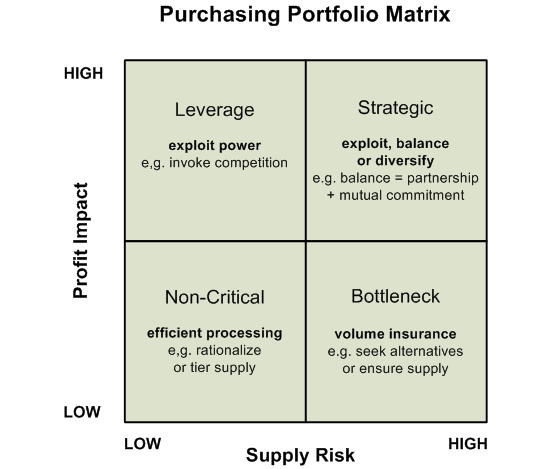
I have always been surprised at how difficult it is for workshop delegates to populate the 'Bottleneck' quadrant of a Kraljic matrix - those procurements which although potentially low price have such an strategic impact on the organisation that they can 'stop the line'.

There appears to be something built into the DNA of those who discuss procurement to focus on managing big sums of money as opposed to managing risks - low value is the unglamorous side of procurement. Yet, delivering great procurement is about identifying the right strategy for all sorts of procurements, including those which are low value but high risk.

You may recall my previous post on the strategic significance of a $10 hinge on laptops - that was an example of a 'Bottleneck' item.

Today (2 August 2013) we have learnt of a somewhat dark procurement example, the dilemma facing the state of Texas as it faces a potential shortage of drugs used for lethal injections for those who it seeks to speed on their journey to the next life through execution. Whether or not you think such a shortage is a good thing is not the point - the issue is a change in the external environment which led to a shortage of supply, in this case relocation of a key supplier to a country which does not want to be associated with execution. I feel it would be totally inappropriate for me to suggest alternative options for the state of Texas but they will need to have some solutions before the end of September [2013].

One of the problems with 'bottleneck' items is that because they are low value they are rarely picked up through a spend analysis which is an over simplification of where to focus attention.

So now you have two examples of 'Bottleneck' items but how specific can you be in identifying your own organisation's or is that a risk not yet managed?

PS: 30 April 2014 As if Texas wasn't bad enough, Oklahoma ended up with botched executions and calls to reveal their suppliers of legal injections.

Wednesday, 24 July 2013

Is there an environment in which procurement fraud is more likely to develop?


If there are reductions in the frequency of exposing purchases to competition through longer-term arrangements, then it is more difficult to demonstrate ‘the price is right’ and suppliers also risk having more at stake from losing business.

If specific individuals have discrete longer-term responsibility for specific purchases in and are perceived to have unique know-how, then visibility of behaviour and critique of strategy is reduced.

If there is a streamlining of processes, which removes what were considered to be ‘non-value added’ checks and balances, then the likelihood of detection is reduced.

If there has been a switch to high-level strategic audit as opposed to random in-depth end-to-end process auditing then the likelihood of fraud being uncovered is reduced.

If there is a feeling of loyalty to the organisation not being reciprocated with loyalty to the individual, then it is more likely that employees will feel a sense of betrayal and anger. 

If there is job uncertainty, doubts about long-term security, a high probability of redundancy, worries about being able to get future employment, pay mortgages and family bills, it is likely that the temptation to engage in procurement fraud will increase.

If there is organisational complacency the procurement fraud only happens in other organisations, then there is a denial of reality.

Is there an environment in which procurement fraud is more likely to develop? Yes, right now.


First published as a guest blog on Procurement Insights, 10 July, 2013


Wednesday, 17 July 2013

The unfortunate case of sponsorship procurement: A case study

I recently discussed the procurement of sponsorship - little did I realise that procurement of sponsorship would become quite a big political issue for London so quickly. Now we learn that Boris has found terms written into the sponsorship agreement of the Emirates Air Line (Cable Car) so unpalatable that a re-write of the 10 year sponsorship deal is required.

The are at least five issues;

  1. The average man in the street knows Boris Johnston is quite outspoken - how was he unaware of a constraint in the sponsorship deal which prohibits any criticism of the deal, the UAE royal family and government? That was a big constraint but also the associate risk required careful management and a high-level of awareness;
  2. The contract would be in breach if the cable service is sold off or assigned as security to a 'conflicting person' or business from a country with which the UAE has no diplomatic relations - which effectively includes any Israeli linked business - how was that constraint signed;
  3. Given the alleged "anti-Israeli" clause, was the contract subjected to any equalities impact assessment?
  4. Were procurement even involved in this deal?
  5. How many other sponsorship contracts exist within TfL which have not been risk assessed?
We are told the contract will now be rewritten - the need for a rewrite is not only an embarrassment but also recognition of a failure to get it right in the first place. This is a lesson for all - get on top of procuring sponsorship before it get's on top of you. The acceptance of the need for contract re-negotitions in the public sector is becoming all to frequent an occurrence - just how long will this be considered reasonable?


Thursday, 11 July 2013

"Generally the MoJ is seen as doing good work in the procurement area"?

I'm going to leave it to others to dissect the G4S and Serco overcharging for tagging the Ministry of Justice. I fully expect a deluge of blogs. Nor do I intend to catalogue the long list of MoJ procurement issues which I have discussed previously.

But I will remind you that last September I highlighted the need to question the value for money of tagging and indeed the need to question the procurement approach including the failure to focus on outcomes.

I also want to remind you that I questioned the value of evidence given to the PASC Procurement Inquiry when one of the 'experts'' stated "Generally the MoJ in seen as doing good work in the procurement area".

The big issue to me is the decision of the Lord Chancellor to launch and internal investigation into contract management based on evidence that MoJ officials knew as far back as 2008 that there were issues with billing. If that proves to be true our profession has been discredited.

I want to learn of the evidence that was uncovered and why that wasn't reported? I want to know how broad, deep and high the awareness went? I want to know whether fraud was involved or corruption? I want to know how much money this has cost the tax payer? I want to know what will happen to tagging if there are only two providers and both are found at fault? I want to understand how these organisations have become so powerful suppliers to the public sector that it appears a blind eye is turned to past misdemeanours? I have long called for personal accountability, will we see that?

Prior to the separation of the MoJ from the Home Office, the then Home Secretary claimed the Home Office "wasn't fit for purpose" - I think we now need to understand what the MoJ Procurement Capability Reviews revealed (written and unwritten - think CQC) and how much of public procurement just isn't fit for purpose?

Wednesday, 10 July 2013

Corruption is a UK problem too

Transparency International has just published its Global Corruption Barometer, sadly it is not good news for the UK . There is now a perception that the UK political system appears to have lost its puritanical past. That's hardly surprising when you think of the recent boasts of some parliamentarians that they can 'make things happen'.

We may like to believe that the Bribery Act will stop all that nastiness but if we do we fail to recognise basic human nature, temptation, and opportunistic behaviour. We also fail to recognise that those who were subjects of the recent parliamentary 'stings' would also been involved in bringing the Bribery Act into law.

To make matters worse there is a political storm in Northern Ireland, where the traditionalist and protestant fundamentalist Democratic Unionist Party have become embroiled in internal allegations of using party influence to skew public procurement decisions. Even the First Minister, doesn't know who to believe. The claims were made as part of a BBC Spotlight programme and of course the DUP are naturally calling into question the reporting (as an aside you may recall that it was a BBC Spotlight programme which had previously raised public procurement questions regarding Peter Robinson's wife and the awarding of a catering franchise a few years ago). While perverting procurement decisions is bad, the DUP now appear to want to obstruct a fuller debate on the issue. The saga of the actual contracts in question is just so bizarre that a weeks blog posts couldn't bring you up to speed but by way of example it involves a firm who admitted charging for maintenance work on blocks of flats which no longer existed!

My advice to the DUP would be to open this whole saga up to as much scrutiny as possible otherwise it will become a running sore.

But we also need to look wider than the UK for frustration with corruption in public procurement - let's not forget that one of the reasons for the recent protests in Brazil was frustration with corruption.

Those involved in public sector procurement, regardless of whether they are politicians or practitioners need to be perceived to be 'whiter than white', particularly when there are spending cuts and the population are on the receiving end. Yet, in how many public sector organisations do we now see evidence of a robust approach to 'owning' and combating the corruption problem or even personal accountability? I don't view this as something which will just 'go away' unfortunately, given the right conditions, which I think we have, I think it can only get worse.

Saturday, 6 July 2013

Should we cheer or castigate the BBC's dreaming

Just over a month ago the BBC was heavily criticised over its failed Digital Media Initiative. Today 'auntie' is in the firing line over abandoning 3-DTV "as another costly failure". Do you think the criticism is right?

£100m was spent on the digital media initiative before failure was admitted, we don't know how much the 3-D dream has cost. I don't really think you can blame the BBC for the reality that so few of us have bought 3-D televisions - the analogue switch-off forced many to replace TVs which really had nothing wrong with them and the economy meant that replacement of TVs was not something necessarily welcomed - why would anyone upgrade again to 3-D so soon?

But if the UK really wants to feature in the new digital age, is it not appropriate that state funded organisations, such as the BBC, should be encouraged to innovate and lead the way in thinking and experimentation. If the Digital Library and 3-D had turned out to be massive successes would the government not have wanted to use those as exemplars?

I think we should cheer the BBC for its dreaming and trying, and I sincerely hope these recent failures will not stop the dreaming and trying. However, we need to learn the lessons of failure. We need to learn how to be faster at spotting the failures and put in the checks and balances to protect the innovators from themselves without stymying their vision. Our industrial strategy needs to reflect this too.  The UK lacks dreamers and visionaries but we also tend to deify them and reward with a seat in 'the Lords'.

Procurement needs to work out ways which can help costly innovation mistakes going too far. Gateway reviews should help but clearly haven't. We need more prototyping. We need to also be part of the innovation team.

Procurement has another role, not just in stimulating the market to innovate but also being more innovative in procurement practice. Do you not find it strange that the global financial crisis has not led to any paradigm shift in procurement thinking? Where is the zeitgeist? Have we not just dis-proved, that in procurement terms, 'necessity is the mother of invention'?

If we want to move forward we have to accept sometimes the stat-nav just doesn't work and we have to go back to the drawing board. Sadly, the BBC appear to have let two projects go too far, but that doesn't mean we can't learn constructively and help successfully turn more dreams into reality.


Tuesday, 25 June 2013

A balanced approach to probation outsourcing

I've discussed the outsourcing of the probation service on a number of occasions but today revealed a strange 'spin' which requires re-balance and critique if the best option and approach is to be selected.

We have learnt that "Officials have warned the Justice Secretary", but then that the warning is actually in the form of a risk register. Of course there should be a risk register which identifies risks in as objective a manner as possible, but risks 'might happen', it doesn't mean they 'will happen'. Is it fair refer to inclusion is a risk register as a 'warning'?

Then we learn that a "a criminal justice expert said the Probation's sell-off is being carried out too hastily; there is too much risk. It is highly likely that service delivery will collapse and public protection will be undermined. The Government must think again". Well if you heard that from a 'criminal justice 'expert' you'd assume an objective opinion, but if you were then told that 'expert' had been a trade union representative of the probation service perhaps you'd consider the opinion highly subjective and more than a little biased?

The Times. which report that they have seen the risk register, appear to have been a victim of spin and not managed the risk of being a pawn well.

From a procurement perspective, whether or not we agree with outsourcing, we should applaud comprehensive risk registers, but we should also avoid being too influenced by subjective opinions. Professional procurement requires robust options appraisal and risk management as opposed to scare mongering.

Saturday, 15 June 2013

Taxpayers Alliance procurement assertions are flawed

Today's Times makes great play of The Taxpayers' Alliance, Bumper Book of Government Waste. Not only does public procurement get a bashing on page 4, but also in an Opinion piece from Matthew Sinclair (Chief Executive of the Taxpayer's Alliance) on page 26.

When I read that £15bn a year could be saved through better public procurement naturally I looked for the evidence. That led me to the source being cited as the Institute of Directors. But the Institute of Directors hadn't identified £15bn could be saved, their source was Colin Cram's report, Towards Tesco.

Now I have deliberately stayed clear of the procurement family spat on Towards Tesco, not least because I like and have great respect for those presenting the opposing arguments. However, we have to remember that the Towards Tesco was based on big assumptions too - it also stated there was an absence of reliable data.

I have serious concerns about the pragmatism of the centralisation argument and I'm not even sure if Colin's argument has been correctly interpreted. But we have reached a dangerous stage when a hypothesis presented by Colin, who is clearly committed to public procurement, is being misinterpreted and used by the Taxpayers' Alliance. We need to end the rhetoric and move to robust peer reviewed evidence to get to the most likely outcome. In the meantime, perhaps we should take all the other Taxpayers' Alliance assertions with a pinch of salt.