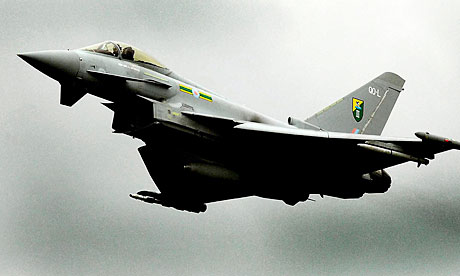
Is it really five years since I last discussed the TAC associated with fighter jets and problems with not getting it right? Well, regardless of that the Times have now started to reveal the sad story of their investigation into yet another 'flawed' procurement of fighter jets - one commentator says "it is turning into an object lesson in the pitfalls of procurement". Yes, TAC still remain unproven art.
Yesterday's Times had six pages on this 'crime of procurement' and given the long history of implied incompetence of defence procurement globally, I suppose this is an easy target.
While I was immediately drawn to the story with a pejorative attitude towards the procurement when I reflected I wonder if MOD procurement are being fairly criticised.
I do think there are serious flaws if, as is implied, a performance specification wasn't used which would have ensured that Lockheed carry the risk of ensuring vertical take off capability, and that the jets have to open bomb bay doors to compensate for overheating. I think some steps should have been taken to protect against the falling exchange rate, which it is thought will have added over an addition £1Billion. I think it was a mistake not to include the cost of spares from suppliers who could perhaps hide other future profits, after all the MOD will be held hostage to the supplier for the life of the jets. Then there's the decision not to buy a Battlefield Airborne Communication Node (BACN) which will enable secure undetectable communications - let's face it once the enemy knows your position the jet could potentially be up in smoke.
Having said all that, it does strike me that some criticism levelled may not be reasonable. For example, assuming that there should have been a blank cheque to upgrade the wider MODs protection against cyber attack - you have to have a blueprint with a strategy of getting there but it would be unreasonable to criticise this specific procurement for that strategy.
Yesterday's 'reveal' may only be the first instalment of evidence of a procurement debacle and perhaps the worst is yet to come. A quick glance at today's diverts attention to the other old favourite, HS2.
Showing posts with label MOD. Show all posts
Tuesday, 18 July 2017
Friday, 6 January 2017
Pirates of the Specification
Buying ships shouldn't be such a big deal if you've a legacy of being one of the great naval nations of the world; you'd have had experience of buying ships to cope with the ice of the Antarctic and the dealing with the Pirates of the Caribbean. Therefore, for many it will have come as a surprise that £1bn of warships are breaking down in the Gulf since the water is too warm, leaving crews vulnerable!!!
The contractors claim the MOD didn't tell them about that particular potential usage, even though the UK has been engaged in flighting there since 1990, if I am correct, and in truth we could go back centuries. Have the MOD locked themselves into a strategy which requires a portfolio of ships which can only be used in restricted climates? If that was the case, the old news stories of warships being redeployed from various parts of the globe to potential conflict areas will be no more, for the simple reason they wouldn't work.
Setting that aside, now it looks as if a refit of these particular Destroyers will be necessary.
I assume the courts will have to decide who picks up the cost but already it looks as though the contractor is trying to escape liability by resorting to the technical specification set out by the MOD - in other words Rolls Royce complied with the letter of the specification so it's not their fault:
Are the conditions experienced in the Gulf in line with that specification? No, they’re not. So the equipment is having to operate in far more arduous conditions than were initially required (Tomas Leahy of Rolls Royce).
I assume we will hear eventually if the MOD used a solely technical specification, but this must serve as a warning to all those who do that using a solely technical specification shifts the burden of functionality to the buyer. To me there will always be a basic need for technical specifications but they need to be accompanied with functional and performance specifications; and when a service is involved, outcome specifications. It certainly looks, at face value, as if the MOD set aside the functional and performance aspects, and, if that is the case, why?
But there's another question here, what about all the talk of supplier partnerships and innovation transfer - was that a one-way street from the MOD to the market without reciprocation? The relationship between the MOD and its strategic partners now looks as if it has suffered a major set-back and will take some time to recover.
To me there is one lesson for all procurement professionals here: never resort solely to a tec spec.
Friday, 25 November 2016
Gove turns his guns on procurement and programme management
One time thought to be a contender to become PM, former Secretary of State for Education, and Secretary of State for Justice has set his sights on public sector procurement and programme management professionals today, in a Comment piece in the Times. I will watch with interest the Letters section to see if CIPS reply.
Gove does a fine job of cataloguing procurement and programme management disasters. Indeed, many of the cases he cites are those I have blogged about in the past and/or used as case studies when training. I will spare you an echoing of the cases; the average man or women on the street is familiar with many of them anyway.
While it is interesting that Gove has put pen to paper on a subject dear to many of us, what is particularly interesting is who he considers to blame - the 'Sir Humphrey's but not the Ministers.
Gove calls for a shift to weekly reporting on progress to Parliament of procurements and programmes. Would there be enough Parliamentary time and, if there was the time, would we see any interest from MPs?
Controversially he also wants to
Also worrying is the implication that civil servants are being influenced by lobby groups. Can he really believe that, and if he does, why doesn't he blow the whistle on what really amounts to corruption.
This, one time, very influential political may well have lost a lot of his power, but should he ever regain it, CIPS will have a major problem if they don't educate the former Secretary of Education now.
Gove does a fine job of cataloguing procurement and programme management disasters. Indeed, many of the cases he cites are those I have blogged about in the past and/or used as case studies when training. I will spare you an echoing of the cases; the average man or women on the street is familiar with many of them anyway.
While it is interesting that Gove has put pen to paper on a subject dear to many of us, what is particularly interesting is who he considers to blame - the 'Sir Humphrey's but not the Ministers.
Gove calls for a shift to weekly reporting on progress to Parliament of procurements and programmes. Would there be enough Parliamentary time and, if there was the time, would we see any interest from MPs?
Controversially he also wants to
see the names of civil servants responsible for these programmes to be published, their explanations for failure (or success) recorded and those who've failed be removed while those who can demonstrate clear, measurable, success get promoted. I know this concept- let's call it accountability - may be somewhat revolutionary for our civil service.This is an interesting notion but isn't Gove missing the point about why we have Ministers in charge of government departments? It is the democratically elected politicians who have to call those in their own departments to account. It is the democratically elected politicians who have to rein in the pursuit of unrealistic political timescales. It is the democratically elected politicians who have to develop the skills to scrutinise and manage professionals to ensure that they deliver on their objectives. Yes, perhaps civil servants need to use a louder voice in explaining to politicians the risks of pursuing some projects. But you can't just point the finger at the civil servants without recognising a failure of political performance management.
Also worrying is the implication that civil servants are being influenced by lobby groups. Can he really believe that, and if he does, why doesn't he blow the whistle on what really amounts to corruption.
This, one time, very influential political may well have lost a lot of his power, but should he ever regain it, CIPS will have a major problem if they don't educate the former Secretary of Education now.
Friday, 18 November 2016
Brexit preparedness and armoured vehicles - what's so hard about that for procurement?
Just in case you wondered why I hadn't blogged recently, it is quite straight-forward, I've been very busy on my day job and haven't found much to say or add to the current procurement debates. I've also been really frustrated with obvious lack of preparedness to the Brexit vote - I wrote an article in Public Money and Management in March 2015 which warned:
However, excuse that bit of "I told you so" - what do you make of the story in today's Times: 'MOD accused of sham contest for armoured vehicles contract'? The gist of the story is that there are insinuations that the MOD is engaging in a procurement process while already having made up its mind what the outcome will be. Apparently, the "preliminary market engagement" has been worded in such a way as to reduce the options to one, even though, functionally, it would appear there are significantly lower priced alternatives available! The process is underway at the present and this stage closes on Tuesday coming.
I wonder how the MOD assessed the risk of this procurement exercise? What will happen in the rest of the procurement process?
If it turns out the potential alternative providers chose not to bid, then the media and those bidders will say it was a fix and the tax payer may have lost out - we would never know. If the competing products don't match the needs of those on the frontline but because of media attention is awarded anyway, the frontline users suffer and also the best provider misses out on their competitive advantage. If the alternative providers do submit the required responses and then subsequently aren't shortlisted, it will be perceived as a fix and a very costly fools errant for the bidders. If the alleged preferred supplier wins, at what is considered to be an inflated price, there will be questions, perhaps even allegations of corruption. If the process is scrapped ... I could go on but you get the gist.
This procurement has all the hallmarks of not being a CV enhancer - why on earth can we not think procurement risk and manage it?
... there is growing discomfort in many countries with their membership of the EU. Those working in public procurement policy and practice would do well to consider the 'what if' scenario if the threatened exits from the EU materialize as there would be significant repercussions. (PMM, Vol 35, #2, March 2015, p.95).Well the news this week certainly suggests my warnings should have been heeded more widely across the UK public sector.
However, excuse that bit of "I told you so" - what do you make of the story in today's Times: 'MOD accused of sham contest for armoured vehicles contract'? The gist of the story is that there are insinuations that the MOD is engaging in a procurement process while already having made up its mind what the outcome will be. Apparently, the "preliminary market engagement" has been worded in such a way as to reduce the options to one, even though, functionally, it would appear there are significantly lower priced alternatives available! The process is underway at the present and this stage closes on Tuesday coming.
I wonder how the MOD assessed the risk of this procurement exercise? What will happen in the rest of the procurement process?
If it turns out the potential alternative providers chose not to bid, then the media and those bidders will say it was a fix and the tax payer may have lost out - we would never know. If the competing products don't match the needs of those on the frontline but because of media attention is awarded anyway, the frontline users suffer and also the best provider misses out on their competitive advantage. If the alternative providers do submit the required responses and then subsequently aren't shortlisted, it will be perceived as a fix and a very costly fools errant for the bidders. If the alleged preferred supplier wins, at what is considered to be an inflated price, there will be questions, perhaps even allegations of corruption. If the process is scrapped ... I could go on but you get the gist.
This procurement has all the hallmarks of not being a CV enhancer - why on earth can we not think procurement risk and manage it?
Tuesday, 26 February 2013
What happens when you ask 1 Knight, 2 Professors, 1 Dr and 1 CEO a simple question on procurement?
Today brought, as I understand it, the final oral evidence session of the Public Administration Select Committee Inquiry into procurement. That's three sessions of oral evidence and heaven only knows how many words of written evidence. I have already discussed the Inquiry and the need for caution in taking opinions.
Now I am wondering what on earth the Select Committee are to make of the evidence taken.
Today's evidence was generally focussed on the complexities of Defence Procurement and the answers came from a Knight (KCB), two Professors, a PhD and a CEO. You would have expected differing views, but I would have expected them to have been able to answer simple questions, for example:
Now I am wondering what on earth the Select Committee are to make of the evidence taken.
Today's evidence was generally focussed on the complexities of Defence Procurement and the answers came from a Knight (KCB), two Professors, a PhD and a CEO. You would have expected differing views, but I would have expected them to have been able to answer simple questions, for example:
- Define Value for Money? and,
- Explain what reverse auctions are, how they work, and what are the benefits?
Alas that proved too difficult for the 'distinguished panel' and the Select Committee are left scratching their heads.
Some wonderfully digressing opinions into the world of 'SMEs don't get a bad deal in public procurement', defence contractors don't gain from the business of war, the UK strategy for supporting the over throw of Gadaffi, indecisiveness of whether UK Defence Procurement is/is not world class, 'we don't have a defence manufacturing strategy - oh yes we do', etc.. But a strange thing seemed to happen - some nonsense was being talked but the 'distinguished panel' appeared unable to pluck up the courage to challenge the nonsense. Instead the 'distinguished panel' opted to exchange polite smiles - I suppose that's what happens when you've a Knight, two Profs, a Dr and a CEO behind one table!
Having said that, Professor Christopher Bovis of University of Hull absolutely shone and was able to succinctly articulate a 'can do' approach within the law, and there were other useful nuggets particularly around GOCO. Other than that, opinions and a lack of critical evaluation.
Yes, what on earth will the PASC make of that evidence? Thankfully the PASC seemed to be well informed and knew their subject.
PS If you do choose to view the evidence watch out for some great examples of physical behaviour to avoid when a camera is on you which are too bad good to share!
Friday, 25 January 2013
Tragic low for procurement & the need for clarity
I started this week saying: "I hope this week we are freed from the embarrassment of another high profile procurement failure". It is therefore a major disappointment to learn that the death of 14 year old army cadet, Kaylee McIntosh, in 2007, has been linked to procurement failures.
Procurement was not the only organisational failure:
“HSE’s investigation has confirmed that primary failings during the activity amplified a number of significant underlying organisational failures. In particular, there was evidence of poor planning, leadership and execution of the exercise, coupled with inadequate oversight, procurement, monitoring and training arrangements. These all contributed to the events that took place."I have absolutely no idea what the procurement failures were and it would be wrong to sit in judgement. Nevertheless, we need to understand what were perceived to be the procurement failures. We need to be reassured that those who came to the conclusion of procurement failures were sufficiently competent to point the finger at procurement. We also need to learn so that Kaylee's tragic death in some way helps reduce the remotest risk of a future tragedy. I hope CIPS, as the professional body, will take the initiative in demonstrating contrition and helping us all learn.
Labels:
CIPS,
HSE,
lessons learnt,
MOD,
PRM,
Procurement Risk Management,
risk
Sunday, 14 October 2012
Can MOD procurement be influenced by ex-Generals?
Today's Sunday Times carries an Insight Investigation into MOD procurement, claiming that ex-generals are available for lobbying those who make procurement decisions. The focus of the report appears to be on the so-called 'revolving door'. That presents only one side of the potential problem.
Whether or not the Generals are breaching agreements and lobbying too early, to me, is irrelevant. What is relevant, yet doesn't appear to have been probed, is why do both the lobbyists and the Generals appear to believe that investment in them will pay dividends?
Surely, it implies that the Generals, who were formerly MOD staff, did see and experience procurement decisions improperly influenced - that has to be the real issue. If procurement decisions have been influenced in the past, we need to know and we need to see the full might of the Bribery Act 2010 brought to bear. Of course, if the Generals are found to be misleading and self-serving, they need to be discredited and an end brought to the implied allegations against MOD procurement. We need to have a reassurance that such enormous sums of of public money are spent honestly; up to now we have had no cause to doubt that. Now the Generals have muddied the waters the doubt has to be removed. The Generals have cast aspirations on MOD defence; they have brought shame on the organisation with which they should have had greatest pride. Shame on them. Shame on us if we don't remove the doubt.
Whether or not the Generals are breaching agreements and lobbying too early, to me, is irrelevant. What is relevant, yet doesn't appear to have been probed, is why do both the lobbyists and the Generals appear to believe that investment in them will pay dividends?
Surely, it implies that the Generals, who were formerly MOD staff, did see and experience procurement decisions improperly influenced - that has to be the real issue. If procurement decisions have been influenced in the past, we need to know and we need to see the full might of the Bribery Act 2010 brought to bear. Of course, if the Generals are found to be misleading and self-serving, they need to be discredited and an end brought to the implied allegations against MOD procurement. We need to have a reassurance that such enormous sums of of public money are spent honestly; up to now we have had no cause to doubt that. Now the Generals have muddied the waters the doubt has to be removed. The Generals have cast aspirations on MOD defence; they have brought shame on the organisation with which they should have had greatest pride. Shame on them. Shame on us if we don't remove the doubt.
Tuesday, 15 May 2012
"Never take your foot of the [procurement] reform pedal"
"Procurement reform remains one of the biggest challenges and its success is vital to ensure that hard-won gains do not unravel. Reform has to be a process of constant revolution, with the toughest decisions pushed through as quickly as possible, often in the teeth of opposition. If you lose momentum in this process, you are done for."
I read the above Opinion piece by Liam Fox, the former defence Secretary of State, in today's Times (p.20). The comment was specifically about Ministry of Defence procurement but I felt it was so transferable to procurement improvement, in general, it just had to be shared.
Monday, 16 April 2012
TAC and the choice of fighter jets
The latest saga in the fighter jet and aircraft carrier saga provides a good case study. Rather than the preferred option being 25% lower, MOD are now faced with the cost of justifying an increased upfront cost of £1.8bn, as opposed to the previously predicted £400m. That's quite a difference and I'm sure many of you ask, 'How could your calculations be so far out?' Getting the predicted figures wrong is understandable but making the wrong choice somewhat harder to justify.
If you were asked to calculate TAC for a fighter jet you may well have done a comparison of the alternatives and really looked at running costs, maintenance costs, etc., but would you have included the additional costs of
Friday, 24 February 2012
Do your procurement systems provide protection for staff?
A news story this week in Northern Ireland was concerned with procurement fraud. You can read part of the story through the BBC link but in a nutshell it's cash for MOD contracts, £16.2m fraud, and three guilty on 17 counts of corruption. Sentencing awaits.Behind the story, I'm told, were some process weaknesses which I have also noticed elsewhere. I'm not going to waste your time with all the ins and outs, but the key lessons are:
- Review your processes for receipt of bids (quotations and tenders)
- Make sure there is a clear separation of duties (procurement staff should not handle the adminstration of receiving bids)
- Make sure bids reamain unopened until after the latest time for receipt
- Make sure more than one person is present at the opening
- Schedule all opened bids
- Initial each submission against the price
- Only then pass to procurement staff
- Procurement check that handover documents.
Wednesday, 1 February 2012
Wiggle room for revisiting public procurement decisions
Today I’m also asking myself, how could that happen? This time the UK are convinced that they have
scope to regain entry, after being excluded, to the bidding process for the
Indian government’s procurement of £10bn worth of fighter jets. France are the now the ‘last man standing’
in the procurement negotiations.
What could possibly have gone wrong that the UK bid isn’t
through to the final stage? Although we have yet to hear what the debriefing
will reveal, included in the suggestions is
Subscribe to:
Posts (Atom)