Showing posts with label portfolio analysis. Show all posts

Thursday, 25 May 2017

An Olympian challenge for sustainable procurement and user satisfaction

In a drawer beside me I have a suite of NIAAF medals, yes, surprisingly, some years ago I was an international athlete!  The medals have personal memories attached to them; I can remember something of each one of those races even now, over 20 years later.  The medals are also something of a tangible legacy which I have always viewed as worth passing to my children and grandchildren.  When I received them, even though I wouldn't be able to retain my fitness, I never gave a second thought as to whether or not the medals wouldn't be durable.

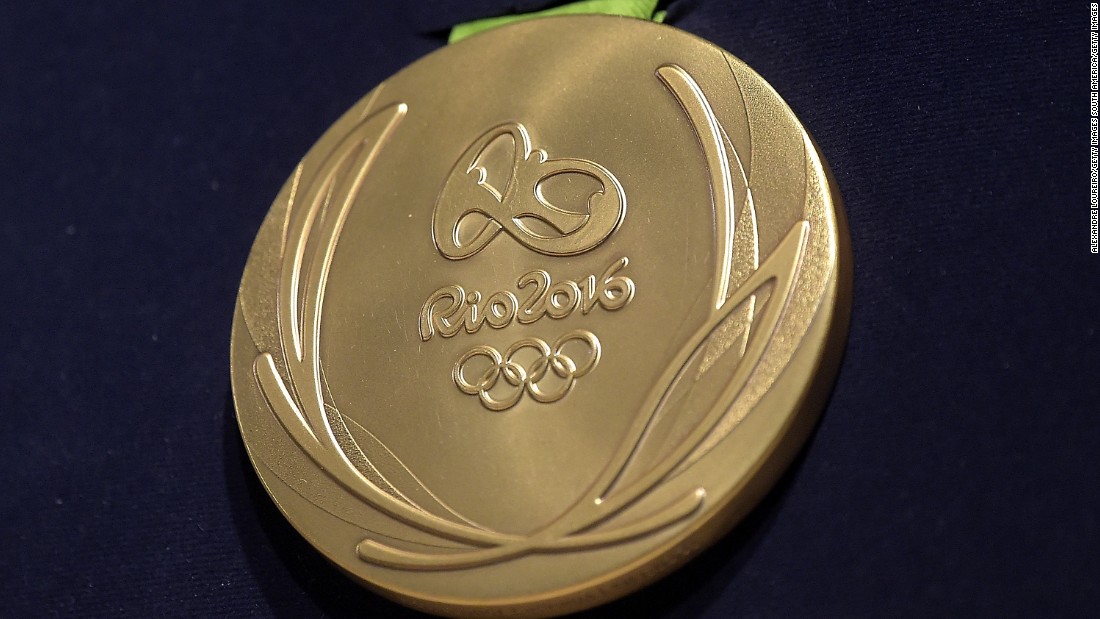
I never had any illusion of being able to win an Olympic medal but I'm sure those who have done assumed their medals would last the distance.  Now we learn that somewhere in the region of 7% of the Medals awarded at the Rio Olympics are starting to wane. It is somewhat ironic that the medals were celebrated for their sustainability - materials used included recycled silver and industrial waste.

Olympic medals are unlikely to have been included in the high cost/high risk profile but that doesn't mean they shouldn't have been subject to a risk assessment and evaluated on the basis of fitness for purpose. That fitness for purpose should have included something of the users perspective too.  It can only be assumed that evaluation didn't take place or, if it did, wasn't given a great weight. The Rio Olympics procurement has once again become a talking point for all the wrong reasons.  Wouldn't it have been easier to have got it right and managed the reputational risk!

But the damage through this lackluster procurement also casts a shadow over the approach to sustainable procurement - instead of acting as a role model it now will serve as an impediment. Sustainable procurement doesn't need to compromise fitness for purpose and shouldn't.

Perhaps the lessons from this are:

  • Consider the specifications others have used, perhaps through consulting with peers; 
  • Place performance and functionality in the perspective of the user;
  • Consider the risks to functionality in the specification and award criteria;
  • Remember the potential for reputational damage in your risk assessment;
  • Test functionality perhaps in the lab;
  • Don't compromise performance and functionality for the glister of sustainable procurement PR.

Friday, 2 August 2013

Execution bottlenecks in procurement

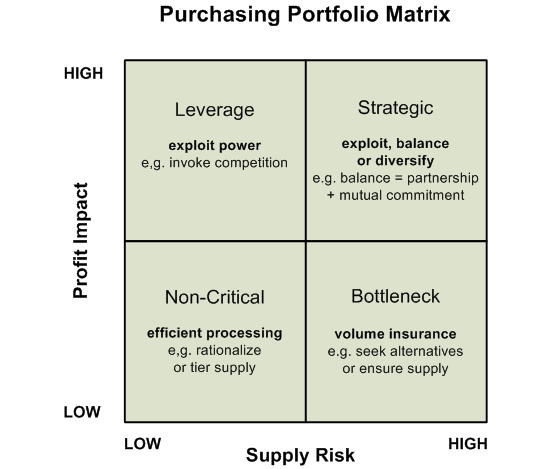
I have always been surprised at how difficult it is for workshop delegates to populate the 'Bottleneck' quadrant of a Kraljic matrix - those procurements which although potentially low price have such an strategic impact on the organisation that they can 'stop the line'.

There appears to be something built into the DNA of those who discuss procurement to focus on managing big sums of money as opposed to managing risks - low value is the unglamorous side of procurement. Yet, delivering great procurement is about identifying the right strategy for all sorts of procurements, including those which are low value but high risk.

You may recall my previous post on the strategic significance of a $10 hinge on laptops - that was an example of a 'Bottleneck' item.

Today (2 August 2013) we have learnt of a somewhat dark procurement example, the dilemma facing the state of Texas as it faces a potential shortage of drugs used for lethal injections for those who it seeks to speed on their journey to the next life through execution. Whether or not you think such a shortage is a good thing is not the point - the issue is a change in the external environment which led to a shortage of supply, in this case relocation of a key supplier to a country which does not want to be associated with execution. I feel it would be totally inappropriate for me to suggest alternative options for the state of Texas but they will need to have some solutions before the end of September [2013].

One of the problems with 'bottleneck' items is that because they are low value they are rarely picked up through a spend analysis which is an over simplification of where to focus attention.

So now you have two examples of 'Bottleneck' items but how specific can you be in identifying your own organisation's or is that a risk not yet managed?

PS: 30 April 2014 As if Texas wasn't bad enough, Oklahoma ended up with botched executions and calls to reveal their suppliers of legal injections.