Today's news that allegedly three more Tesco staff, who have links with procurement, have been suspended continues to rub salt in the wound and negatively impact on reputation.
While I have discussed Tesco's procurement many times, I now find myself asking: "is the weakness in the governance and policy as opposed to the people?"
If the press are correct, those suspended now include: the commercial director, the food commercial director, three category directors (group wine director, director of convenience foods, and director of impulse purchases) and someone responsible for sourcing.
It seems impossible to believe all those suspended are mavericks or indeed that they were pursuing a strategy concealed from those with strategic oversight. If that is possible, then how many other areas of Tesco's governance lacked scrutiny?
Nevertheless, it may be a good time to gain insights into the procurement governance and policy of Tesco. If that was a fault, you can hardly blame the staff. Even if Tesco replace the staff, in the absence of addressing governance and policy failures, the corrections will only be cosmetic.
It may also be a good time for those charged with procurement governance and policy to ask, "could Tesco's woes be replicated here?".
Showing posts with label strategy. Show all posts
Tuesday, 14 October 2014
Is the Tesco storm indicative of a governance & policy failure?
Labels:
audit,
category management,
culture,
governance,
partnerships,
PRM,
Procurement Risk Management,
procurement strategy,
retail procurement,
scrutiny,
sourcing,
strategic sourcing,
strategy,
tesco
Friday, 12 September 2014
For want of a compelling strategy
I must have read hundreds of Procurement Strategy documents, many of which were 'cut and paste' of another organisation's. The Strategy document sets out the directional plan for the coming period and signposts to the future desired state, it also provides the framework for making operational and tactical decisions. In getting ownership of the Strategy, the author, or their champion, needs to negotiate and 'sell' to key stakeholders. Of course we recognise that there is frequently a gap between the documented 'intended' strategy and what subsequently happens, the 'realised' strategy. The truth is that many of the documents I have read actually lack any To-Be, indeed many lack an ambition or need for change.
It is against that backdrop I read with interest that Dunelm have chased their chief executive, even with an increase in profit, over failure to reach agreement on strategy. The Directors wanted a more ambitious strategy and the CEO failed to set that out. It is also interesting that the Directors didn't like the realised strategy which led to criticism that: "The stores look a bit more organised, a bit clearer, a bit easier to wheel a trolley around ...". We do not know whether or not the Board had previously endorsed that strategy or whether the realised strategy differed from the agreed intended strategy.
Regardless, I wonder how many CPOs need to take heed of the example of the Dunelm example, ensure they have an ambitious strategy with the endorsed ownership of their Procurement Strategy and an implementation plan with appropriate KPIs to ensure implementation.
It is against that backdrop I read with interest that Dunelm have chased their chief executive, even with an increase in profit, over failure to reach agreement on strategy. The Directors wanted a more ambitious strategy and the CEO failed to set that out. It is also interesting that the Directors didn't like the realised strategy which led to criticism that: "The stores look a bit more organised, a bit clearer, a bit easier to wheel a trolley around ...". We do not know whether or not the Board had previously endorsed that strategy or whether the realised strategy differed from the agreed intended strategy.
Regardless, I wonder how many CPOs need to take heed of the example of the Dunelm example, ensure they have an ambitious strategy with the endorsed ownership of their Procurement Strategy and an implementation plan with appropriate KPIs to ensure implementation.
Friday, 4 April 2014
Procurement Space Chess with Russian music
It matters little which side of the fence you sit on the politics of Crimea but what we are observing is an amazing game of strategy, negotiation and brinkmanship. While the West have huffed and puffed Putin has called checkmate and the threats of the recent past have done little to affect change.
This is clearly a historical event being played out and we can expect strategists to dissect and debate for many years to come. But does anyone seriously believe that Russia will now walk away from the Crimea? Did anyone seriously believe that once the Russian masses assembled for 'military exercises' that Putin didn't mean business?
So we observed, powerless, from the sidelines, as Russian soldiers walked in and redrew the Russian border.
Now we find that NASA employees and CONTRACTORS have to freeze co-operation with Russia. While the International Space Station is excluded from the break in collaboration, that must only be due to the US deciding that it would be too painful to break off that co-operation. But surely that just signals to Russia how they can inflict pain on the West.
As we know the US has also lost its independence from Russia to even launch people into space - that's been 'outsourced' to Russia. At some stage the US must have decided on a make/buy decision on space launches, now I suspect they are questioning their 'what if' analysis.
Hasn't the space programme always been about economic benefits. Wasn't the reason for co-operation with Russia about economic benefits and gaining economic advantage. We're now seeing the economic advantages being compromised for political rhetoric. But what if Russia decides that co-oepration with the US is no longer advantageous? What if Russia now starts to co-operative with a different partner, one which shares its longer-term view? Wouldn't those scenarios be detrimental to the US?
This is clearly a historical event being played out and we can expect strategists to dissect and debate for many years to come. But does anyone seriously believe that Russia will now walk away from the Crimea? Did anyone seriously believe that once the Russian masses assembled for 'military exercises' that Putin didn't mean business?
So we observed, powerless, from the sidelines, as Russian soldiers walked in and redrew the Russian border.
Now we find that NASA employees and CONTRACTORS have to freeze co-operation with Russia. While the International Space Station is excluded from the break in collaboration, that must only be due to the US deciding that it would be too painful to break off that co-operation. But surely that just signals to Russia how they can inflict pain on the West.
As we know the US has also lost its independence from Russia to even launch people into space - that's been 'outsourced' to Russia. At some stage the US must have decided on a make/buy decision on space launches, now I suspect they are questioning their 'what if' analysis.
Hasn't the space programme always been about economic benefits. Wasn't the reason for co-operation with Russia about economic benefits and gaining economic advantage. We're now seeing the economic advantages being compromised for political rhetoric. But what if Russia decides that co-oepration with the US is no longer advantageous? What if Russia now starts to co-operative with a different partner, one which shares its longer-term view? Wouldn't those scenarios be detrimental to the US?
Friday, 2 August 2013
Execution bottlenecks in procurement
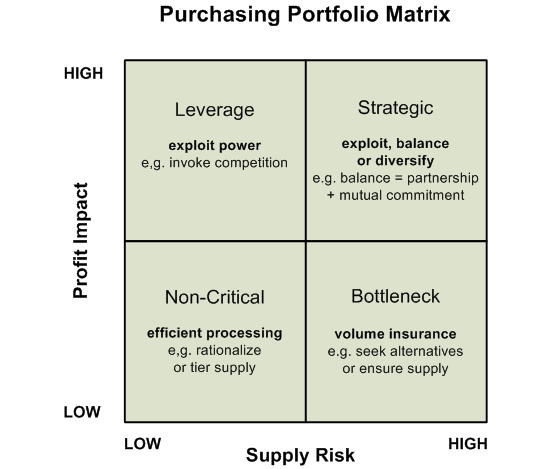
There appears to be something built into the DNA of those who discuss procurement to focus on managing big sums of money as opposed to managing risks - low value is the unglamorous side of procurement. Yet, delivering great procurement is about identifying the right strategy for all sorts of procurements, including those which are low value but high risk.
You may recall my previous post on the strategic significance of a $10 hinge on laptops - that was an example of a 'Bottleneck' item.
Today (2 August 2013) we have learnt of a somewhat dark procurement example, the dilemma facing the state of Texas as it faces a potential shortage of drugs used for lethal injections for those who it seeks to speed on their journey to the next life through execution. Whether or not you think such a shortage is a good thing is not the point - the issue is a change in the external environment which led to a shortage of supply, in this case relocation of a key supplier to a country which does not want to be associated with execution. I feel it would be totally inappropriate for me to suggest alternative options for the state of Texas but they will need to have some solutions before the end of September [2013].
One of the problems with 'bottleneck' items is that because they are low value they are rarely picked up through a spend analysis which is an over simplification of where to focus attention.
So now you have two examples of 'Bottleneck' items but how specific can you be in identifying your own organisation's or is that a risk not yet managed?
PS: 30 April 2014 As if Texas wasn't bad enough, Oklahoma ended up with botched executions and calls to reveal their suppliers of legal injections.
Wednesday, 27 February 2013
Lessons in centralising spend: NAO Report 'Improving government procurement''
The NAO has now published their report on 'Improving government procurement' - perhaps the title is a bit misleading as it is really about the effectiveness of the latest iteration of 'ye olde Buying Agency', the GPS. In many respects it is a recycling of old messages. Nevertheless, 'what goes around, comes around' and I am sure it is no coincidence we have also have the PASC Inquiry into procurement.
Some paraphrased thoughts before you knuckle down for a riveting read of the report though:
- In our world it's always good to understand who is the buyer and who is the supplier. The buyers, in this example, are decentralised budget holding departments and one of the potential suppliers is GPS;
- Buyers expect to set the terms for suppliers - they like caveat emptor;
- If the supplier's Chairman of the Board (Cabinet Office Minister) and Head of Marketing (CPO) say "I'm going to be your monopoly supplier which you must use", that doesn't mean the buyers will necessarily see that as a good thing. Nor does it mean that the alternative suppliers see it as a good thing;
- There's a clear incentive for the buyers and the former suppliers to see the new monopoly as a threat to their freedom, bringing with it the additional risk (barrier to change) of
perceivedpoor quality service, worse prices and complacency. So expect resistance to change, if for no other reason, buyers like buying - visualise images of old ladies fending of those trying to steal their purse; - Equally, if the buyers see this as just the latest iteration of what has gone before (say, ye olde Buying Agency, PSA, BuyingSolutions, etc.) and they were able to stick to their old ways successfully in the past, don't be surprised if they use that strategy again;
- Assuming you are going to encounter resistance to change, it is a good idea to 'sell' rather than 'tell' - 'telling' just encourages resistance to change to your monopoly. 'Selling' involves listening to the customer and setting out compelling, irresistible and realisable benefits which win the buyer hearts and minds over their perceived costs;
- You sell b
uy 'winning hearts and minds' - if you don't win their hearts they will hanker after what suits them best and try to brazen it out. If enough brazen it out, then they will retain the old way; - There are practicalities involved in migrating from buyers old contracts to the sellers new contracts - think about contract end dates;
- If you say "you must use my monopoly or else", you better be sure what "or else" means because if you have no 'stick' they can just say "sticks and stones may break my bones but words will never hurt me, ...";
Friday, 1 February 2013
We need an urgent 'COBR like' response to food procurement
One of my friends is a devout Muslim and I can understand his food vigilance - he places trust in those who prepare his food and confidence in their assurances.
My daughter has a serious peanut allergy. Since she was very young we have gone to great lengths to protect her from peanuts. Wherever she goes, her epi-pens have gone with her (I hope). We've spent years asking airlines to protect her from exposure from peanuts when she's on board (I'm sure you've heard the type of announcements which have caused her to blush). When we go out for meals we place trust in those who prepare her food and confidence in their assurances.
Globally, we have also been concerned with food security - "both physical and economic access to food that meets people's dietary needs as well as their food preferences".
A few years ago I was involved in the Public Sector Food Procurement Initiative. It was a serious, cross-Whitehall strategy to help the UK economy. In all the meetings I attended I just cannot recall any discussion suggesting a lack of confidence in food standards or that what was procured would not be received to specification. Ironically, every meeting included a detailed review of risks to the Programme. UK food procurement has a significant contribution to make to the economy.
How things have changed. We now appear to be stepping into the abbess in terms for food procurement risk.
We all need to eat food, yes, prisoners and those with food allergies too. We all need to buy food to feed ourselves and our nearest and dearest. The horsemeat discussion was able to be side-tracked through the discussion of "at that price what do you expect?". We have now reached a different position - a public sector institutional food procurement failure.
Subscribe to:
Posts (Atom)