I'm sure many readers recall the coalition's pursuit of improvement in public procurement and the desire to listen to 'the great and the good' of business on 'how it should be done'. That led to Sir Philip Green explaining how to fix public procurement - I wasn't particularly impress by his recommendations.
Isn't it interesting that Green has now sold BHS for a nominal £1. Isn't it also interesting that the Consortium which have bought BHS allegedly feel it was unloved and deprived of investment for years.
I wonder whether those who championed Green as a procurement guru still sing his praises? I wonder how many of his recommendations were actually proved to be effective for public procurement in implementation? I wonder how many of those in public procurement feel they are also the victim of the 'Green strategy of unloved and deprived of investment'?
The sale of BHS for £1 says a lot about Green and value for money, but it should also ring out caution when politicians clamor to listen to private sector gurus.
Friday, 13 March 2015
Friday, 6 March 2015
Have CIPS lost the plot on Chartered Status?
Way back in January CIPS trumpeted that individual Chartered Status was available - sounded good. Of course it's only today we discover that caveat emptor should have perhaps applied when we ticked the box in support of Chartered Status.
I have now decided it's not something for me and I will not be pursuing it further, nor of course will I see it as a designation worth considering when recruiting procurement staff - I no longer feel it will be a positive differentiator.
Why? Well, I have an MSc with Distinction in Purchasing & Supply Management - it was awarded by a University and was accredited at the time by CIPS - it was an MSc which was tailored specifically to P&S, not a couple of bolt-on modules. That now seems to count for nothing - it is spent. I find I would need to take another CIPS Accredited MBA or pursue the Experiential Route - cost £795.
I also have MCIPS and a PhD in strategic procurement. Yes, and over 20 peer reviewed academic publications. And yes, I have been full-time in procurement since 1975. I think I can recognise bad value and not fit for purpose when I see it.
I only wish CIPS had been honest with the membership prior to asking for the vote on Chartered Status - I for one would have changed my vote.
I'd really love to know how much the Congress were aware of this approach and want to be accountable for it.
I have now decided it's not something for me and I will not be pursuing it further, nor of course will I see it as a designation worth considering when recruiting procurement staff - I no longer feel it will be a positive differentiator.
Why? Well, I have an MSc with Distinction in Purchasing & Supply Management - it was awarded by a University and was accredited at the time by CIPS - it was an MSc which was tailored specifically to P&S, not a couple of bolt-on modules. That now seems to count for nothing - it is spent. I find I would need to take another CIPS Accredited MBA or pursue the Experiential Route - cost £795.
I also have MCIPS and a PhD in strategic procurement. Yes, and over 20 peer reviewed academic publications. And yes, I have been full-time in procurement since 1975. I think I can recognise bad value and not fit for purpose when I see it.
I only wish CIPS had been honest with the membership prior to asking for the vote on Chartered Status - I for one would have changed my vote.
I'd really love to know how much the Congress were aware of this approach and want to be accountable for it.
Sunday, 8 February 2015
Is Tesco's procurement strategy always wrong?
Readers of this blog will know I haven't been overly sympathetic of all Tesco's woes, however, today I find myself loosely in agreement with a Tesco approach that is the latest focus of criticism. The Sunday Times reports Tesco threatens new squeeze on suppliers' - the criticism based on alleged letters send by Tesco to suppliers demanding a price decrease due to the recent fall in commodity prices.
I do not know the precise wording of Tesco's contracts, but if they were on a Rise and Fall basis, and the supplies in question are directly linked to commodity prices, then I would expect to see price decreases flowing through too. Of course, when the commodity prices inevitably rise, it would then also be fair and reasonable for Tesco to accept corresponding price rises.
I have spent years observing buyers accept the price rises, and on many occasions they have been unjustifiably linked to RPI, etc., yet those same buyers rarely chase the linked price decreases - that's just bad price management and bad procurement. That laissez faire approach to procurement costs businesses money and the profession reputation.
Having said that, if Tesco haven't contracted on a R&F basis, then their cavalier attitude to supplier management suggests they haven't learnt anything of late and deserve all the criticism they get. Nevertheless, perhaps, given the recent history, Tesco may have approached this initiative slightly differently and sensitively.
I do not know the precise wording of Tesco's contracts, but if they were on a Rise and Fall basis, and the supplies in question are directly linked to commodity prices, then I would expect to see price decreases flowing through too. Of course, when the commodity prices inevitably rise, it would then also be fair and reasonable for Tesco to accept corresponding price rises.
I have spent years observing buyers accept the price rises, and on many occasions they have been unjustifiably linked to RPI, etc., yet those same buyers rarely chase the linked price decreases - that's just bad price management and bad procurement. That laissez faire approach to procurement costs businesses money and the profession reputation.
Having said that, if Tesco haven't contracted on a R&F basis, then their cavalier attitude to supplier management suggests they haven't learnt anything of late and deserve all the criticism they get. Nevertheless, perhaps, given the recent history, Tesco may have approached this initiative slightly differently and sensitively.
Friday, 6 February 2015
Tesco, the Groceries Code Adjudicator and CIPS
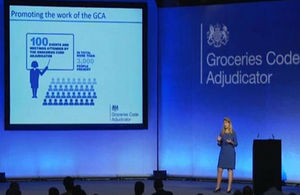
You are probably already aware that the Groceries Code Adjudicator has announced that her first inquiry will be into Tesco's 'supply chain bullying'. Of course this is not the first inquiry to touch Tesco's fallen angel procurement, it joins those of the Serious Fraud Office and the Financial Reporting Council.
You may have thought this was an appropriate time for the newly badged Chartered Institute of Procurement and Supply to show its teeth too, but I was amazed to learn that David Noble, CIPS CX response to the news of the Groceries Code Adjudicator's inquiry was:
"This remedial action is tantamount to closing the stable door once the horse has bolted"What on earth is the business world to understand from such a platitude? Surely, CIPS are not advocating the potential breach of the Code should not be investigated? What action are CIPS proposing to take in demonstrating its own Ethical Code has teeth? Would this not have been the right time for CIPS to have championed the Inquiry and champion good supply chain management practice?
Friday, 30 January 2015
First procurement themed issue of Public Money and Management
The latest issue of Public Money and Management has just been published on line with the hard copy due mid February - it is a procurement themed issue. Not only is it the first in the history of the Journal but
it is truly international with contributions from The UK, The Netherlands,
Brazil, Ireland and Australia.
There are some really useful articles in the issue which provide surprising findings from previously unpublished research. If you would like to read a free copy of my editorial which provides insights into the articles covered - the first 50 can access a free copy at this link
Thursday, 29 January 2015
The impact of belief in value for money
Today's Times includes an interesting report on how perception of a more expensive product influences outcome. The report is based on research published in the American Journal 'Neurology'. In an experiment a group of twelve Parkinson's disease sufferers were given two placebos and told one was more expensive - they were told one cost $110 and the other $1,500. Remarkably those given the perceived to be more expensive placebo actually had a 28% improvement in motor skills compared with those on the same placebo yet perceived to be less expensive!
The researchers think the 'expectation of reward response' may have had an impact on the outcome - interestingly eight of the twelve particiants said that they had greater expectations from the more expensive (placebo) drug.
How often do we hear specifiers refer to evidence of better performance from in a procurement process - could that evidence be based on 'expectation of reward response' or rose tinted spectacles?
t would be interesting to know the impact on an evaluation if evaluation panels were given pricing information which implied higher quality?
Of course it would be unethical and unacheivavble within the Regulations, but what would be the perception of users if they were told a public sector organisation had opted to provide a more expensive solution based on citizen preferences?
The researchers think the 'expectation of reward response' may have had an impact on the outcome - interestingly eight of the twelve particiants said that they had greater expectations from the more expensive (placebo) drug.
How often do we hear specifiers refer to evidence of better performance from in a procurement process - could that evidence be based on 'expectation of reward response' or rose tinted spectacles?
t would be interesting to know the impact on an evaluation if evaluation panels were given pricing information which implied higher quality?
Of course it would be unethical and unacheivavble within the Regulations, but what would be the perception of users if they were told a public sector organisation had opted to provide a more expensive solution based on citizen preferences?
Tuesday, 20 January 2015
A contradiction in make/buy theory
Most of us would agree that, when carrying out an options appraisal as part of the make/buy decision, the theory says retain in-house strategic services which are critical to delivery of the core business. That theory seems to have been turned on its head with the water service to the west of Northern Ireland, where last night almost 8,000 properties were without water. Many have not had water for days and had to resort to melting snow and fetching water from rivers in a scene more akin to third world services.
The problem all revolves around work-to-rule as part of a decision to change the pension rights of NI Water employees (at some stage I may discuss my abhorrence at trying to change pension rights which employees signed up to many years previously). However, some repair work is the responsibility of NI Water employees, while other work is governed by a PPI arrangement with treatment plants contracted out. If there's a problem with the 'contracted out' (buy) treatment plant, the staff responsible for repairs are the contractors as opposed to NI Water and the work is completed. However, where the fault relates to the remit of NI Water staff, i.e. 'make', it is subject to the work-to-rule and that's where the water service has collapsed.
This is a remarkable exception to the theory of make/buy where the in-house delivery is adversely affecting core services as opposed to the 'buy' service!
The problem all revolves around work-to-rule as part of a decision to change the pension rights of NI Water employees (at some stage I may discuss my abhorrence at trying to change pension rights which employees signed up to many years previously). However, some repair work is the responsibility of NI Water employees, while other work is governed by a PPI arrangement with treatment plants contracted out. If there's a problem with the 'contracted out' (buy) treatment plant, the staff responsible for repairs are the contractors as opposed to NI Water and the work is completed. However, where the fault relates to the remit of NI Water staff, i.e. 'make', it is subject to the work-to-rule and that's where the water service has collapsed.
This is a remarkable exception to the theory of make/buy where the in-house delivery is adversely affecting core services as opposed to the 'buy' service!
Subscribe to:
Posts (Atom)