Sunday, 31 May 2015

Are agencies the baddies of NHS procurement

My ears pricked up this morning when I heard the NHS CX, Simon Stevens, explain to Andrew Marr that they were "going to clamp down on some of the staffing agencies ripping off the NHS".  Is this some sort of role reversal taking place - the Conservatives are in power but the market are the baddies!

In the past many public sector organisations believed that their traditional approach of having a 'bank' which they managed and could call on was flawed - outsourcing was the new best practice. Exploring the option of outsourcing did make sense but in parallel there needed to be a proactive approach to managing both the agencies and the internal demand. I observed agencies providing an easier option than the hurdles of sourcing internally through HR. Justifying the need for 'temps' was relaxed and while staff previously covered for short-term absences, that became the exception. The agencies made it easy to just pick up the phone and have a temp sitting at a desk two hours later. Then, months later, like a version of Parkinson's Law, the temp had become indispensable and the temp had become a necessity.

To me what went wrong was that public sector bodies relaxed their control mechanisms - they devolved control. Worse they gave it away. The agencies weren't the baddies, they were 'partners'. But as the clients raised their expectations of demand there was a parallel need to manage risks through prices by the agencies.

Now "some" of the agencies are perceived to be "ripping off the NHS". What happened to the 'intelligent client'? What happened to the belief in competition? What happened to managing contract prices?

Those who believe the market is ripping the NHS off would do well to review the robustness of their demand management. Agencies provide a solution which the public sector has come to rely on. Power has perhaps shifted to the market as opposed to the client. Before assuming the NHS is being ripped off why not consider a ,make/buy options appraisal. Before clamping down they better have a risk management strategy which addresses how they will respond if some of the critical providers just  say "okay, we'll not bid anymore!"

Thursday, 28 May 2015

Is Procurement reputational risk mis-sold?

For many years I have heard about the risk of poor procurement performance damaging reputation - I'm sure you have too, I'm also sure you would have heard it from me too.

Have you ever thought though how adverse impact would be manifested?

The assumption on impact may well have been a share price decline  - bad media coverage about a procurement issue correlating with a decline in share price. At first glance that sounds logical enough but there's a major problem if the firm or organisation in question does not have shares publicly quoted. For example, public sector organisations, third sector organisations and private companies would not be quoted on the stock exchange!

Okay, so setting that aside, and only considering the share price performance of organisations like, Tesco, Premier Foods, Primark, and H&M - yes all these have had adverse national media coverage linked to procurement - could we see adverse impact on share price linked with the horsemeat scandal, wrong use of the Red Tractor QA logo, supplier late payments and profit mis-statement, supplier coercion (e.g. pay-to-stay), the Rana Plaza disaster, poor SCM conditions?

I looked at the quoted share prices, the day before the news story broke, the day after, two weeks before and two weeks after, and even considered the trends over a longer period of two years.

Now what do you think I found? Well it appears to me, without an major statistical analysis, that where you could see an adverse impact, it was short-lived (a blip) and the firm in question was already in a long-term state of a declining share price anyway - the procurement issue is unlikely to have helped but was probably indicative of wider strategic management weakness anyway.

Then bizarrely, in a few of the situations the share price increased. Yes, major adverse press coverage of a procurement related issue and the share price rose and continued to rise - the firm was on a steady long-term upwards trajectory of its share price and the adverse media coverage of the procurement issue appeared to have no detrimental long-term impact whatsoever - perhaps it was how the firm was perceived to have responded to the issue?

Also interesting was when I considered firms which were perceived to have come out well in media coverage, for example, those food retailers who were praised at the time of the horsemen scandal. I couldn't find a tracker which demonstrated a benefit - they were not publicly quoted on the stock market!

What does this tell us? Well the whole threat of potential repetitional damage used in selling procurement strategy may well be mis-selling. Perhaps procurement issues are not as big an issue as we see them? Perhaps nobody really cares? Perhaps the whole notion of measuring adverse impact through share price is flawed?

What do you think?

First published on 28 April 2015 as a Spendmatters guest post

Saturday, 18 April 2015

The UK needs to be an intelligent giver (procurer)

Friday's Times reported an investigation into the UK's "scandal of squandered overseas aid".  At the centre of the story is the UK's commitment to spend 0.7% of GDP on overseas aid - now a legal obligation and endorsed by all three of the main political parties.

The issue is not whether or not the UK should be benevolent, or indeed whether we should be more generous, but Dfid's strategy of channelling the aid through multi-national agencies, such as the EU and the UN without retaining sufficient control and scrutiny of the spending. The suggestion is that the UK have outsourced its giving and, in so doing don't have a voice in scrutiny.

We are led to believe that over £6bn a year is contributed through the international agencies, 60% of the total amount, and that £6bn is not subject to UK oversight.

The giving of this £6bn is actually a procurement - the UK pay out some money in the anticipation of a delivery. Giving through the international agencies does not shackle the hands of the UK in terms of exercising its control. On the contrary the aggregation of the UKs aid with that of other countries should lead to a more strategic approach and more effective targeting. As one of the biggest 'givers', or should we say procurers, the UK is in a stronger negotiating position in demanding reforms and evidence of impact. Demanding reforms and evidence of impact is just good stewardship.

The incoming UK Government need to bring a new assertiveness to the aid strategy. They need to recognise that this is procurement. They need to develop a negotiating strategy. They need to have their own objectives which ring-fence how aid will be spend through the international agencies and they they to significantly improve accountability and performance management. Where that approach is resisted the UK shouldn't withdraw aid but instead redirect through channels where the required level of accountability will be satisfied. That would deliver the required value for money, accountability and improved impact.

Friday, 13 March 2015

Revisiting Green, the procurement guru.

I'm sure many readers recall the coalition's pursuit of improvement in public procurement and the desire to listen to 'the great and the good' of business on 'how it should be done'. That led to Sir Philip Green explaining how to fix public procurement - I wasn't particularly impress by his recommendations.

Isn't it interesting that Green has now sold BHS for a nominal £1. Isn't it also interesting that the Consortium which have bought BHS allegedly feel it was unloved and deprived of investment for years.

I wonder whether those who championed Green as a procurement guru still sing his praises? I wonder how many of his recommendations were actually proved to be effective for public procurement in implementation? I wonder how many of those in public procurement feel they are also the victim of the 'Green strategy of unloved and deprived of investment'?

The sale of BHS for £1 says a lot about Green and value for money, but it should also ring out caution when politicians clamor to listen to private sector gurus.

Friday, 6 March 2015

Have CIPS lost the plot on Chartered Status?

Way back in January CIPS trumpeted that individual Chartered Status was available - sounded good. Of course it's only today we discover that caveat emptor should have perhaps applied when we ticked the box in support of Chartered Status.

I have now decided it's not something for me and I will not be pursuing it further, nor of course will I see it as a designation worth considering when recruiting procurement staff - I no longer feel it will be a positive differentiator.

Why? Well, I have an MSc with Distinction in Purchasing & Supply Management - it was awarded by a University and was accredited at the time by CIPS - it was an MSc which was tailored specifically to P&S, not a couple of bolt-on modules. That now seems to count for nothing - it is spent. I find I would need to take another CIPS Accredited MBA or pursue the Experiential Route - cost £795.

I also have MCIPS and a PhD in strategic procurement. Yes, and over 20 peer reviewed academic publications. And yes, I have been full-time in procurement since 1975. I think I can recognise bad value and not fit for purpose when I see it.

I only wish CIPS had been honest with the membership prior to asking for the vote on Chartered Status - I for one would have changed my vote.

I'd really love to know how much the Congress were aware of this approach and want to be accountable for it.

Sunday, 8 February 2015

Is Tesco's procurement strategy always wrong?

Readers of this blog will know I haven't been overly sympathetic of all Tesco's woes, however, today I find myself loosely in agreement with a Tesco approach that is the latest focus of criticism. The Sunday Times reports Tesco threatens new squeeze on suppliers' -  the criticism based on alleged letters send by Tesco to suppliers demanding a price decrease due to the recent fall in commodity prices.


I do not know the precise wording of Tesco's contracts, but if they were on a Rise and Fall basis, and the supplies in question are directly linked to commodity prices, then I would expect to see price decreases flowing through too. Of course, when the commodity prices inevitably rise, it would then also be fair and reasonable for Tesco to accept corresponding price rises.

I have spent years observing buyers accept the price rises, and on many occasions they have been unjustifiably linked to RPI, etc., yet those same buyers rarely chase the linked price decreases - that's just bad price management and bad procurement. That laissez faire approach to procurement costs businesses money and the profession reputation.

Having said that, if Tesco haven't contracted on a R&F basis, then their cavalier attitude to supplier management suggests they haven't learnt anything of late and deserve all the criticism they get. Nevertheless, perhaps, given the recent history, Tesco may have approached this initiative slightly differently and sensitively. 

Friday, 6 February 2015

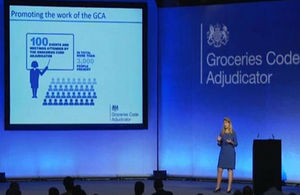
Tesco, the Groceries Code Adjudicator and CIPS

You are probably already aware that the Groceries Code Adjudicator has announced that her first inquiry will be into Tesco's 'supply chain bullying'. Of course this is not the first inquiry to touch Tesco's fallen angel procurement, it joins those of the Serious Fraud Office and the Financial Reporting Council.

You may have thought this was an appropriate time for the newly badged Chartered Institute of Procurement and Supply to show its teeth too, but I was amazed to learn that David Noble, CIPS CX response to the news of the Groceries Code Adjudicator's inquiry was:
"This remedial action is tantamount to closing the stable door once the horse has bolted"
What on earth is the business world to understand from such a platitude? Surely, CIPS are not advocating the potential breach of the Code should not be investigated? What action are CIPS proposing to take in demonstrating its own Ethical Code has teeth? Would this not have been the right time for CIPS to have championed the Inquiry and champion good supply chain management practice?